




1st Edition
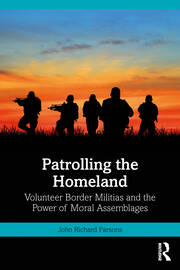
Patrolling the Homeland Volunteer Border Militias and the Power of Moral Assemblages
Patrolling the Homeland - Volunteer Border Militias and the Power of Moral Assemblages
The Struggle for Acceptance
Morality and Comfort
Why Mobilize? A Brief History of Opposition
Positionality
Moving Forward
1. Border Watch
Searching and Hope
Militias, Vigilantes, and the State
Stigma
Media and Image
The Operations
Military Influence
Away from the Border
Border Watch
2. Morality
Comfort
Moral Breakdowns
Discomfort and the Response
Imperatives – External and Internal - the Basis of Comfort
Ethical Affordances – the Internal Imperative
Moral Assemblages – the External Imperative
The Power of the Assemblage
The Moral World
3. Ethnicity at the Nation’s Frontier
Contemporary Concerns
Crossing Borders
A Border Separates ‘Culture’
Assimilation
Freedom of Movement – a Privilege of Hierarchy
Controlling National Space
Ethnicity on the Border
4. Experience, Narrative, and the Moral Imperative to Act
The Narrative World of Border Watch
An Underlying Truth
Narrative
Experience
The Failings of the State
Evaluation and Justification – the Bounds of Assemblages
The Imperative and the Citizen-Soldier
5. Embodied Narrative on the Border
The Purse
An Unknown but Knowable Enemy
Chasing Fire
Authority
Contradiction and the Immorality of the Other
Rape Trees and Immorality
6. The Moral Citizen, Virtue Ethics, and the Internal Ought
Personhood
The Self
The Immoral Other
Incorporating Virtue Ethics
Good Guy with a Gun
Doing What One Ought, Not What One Wants
7. The Comfort to Act
Enjoyment and the Moral Imperative
Protecting Border Watch – The Power of Conformity
Fitting the Mould through Narrations of the Self
Danger and Bonding – the Enjoyment of Missions
Camaraderie
The Shifting of Morals
A World Without Self-Reflection
The Danger of Moral Assemblages
The Future of Border Militias
Biography
John R. Parsons holds a PhD in anthropology from the University of Queensland. His research concentrates on the intersection of morality, narrative, and violence.
"This book is a unique study based upon ethnography in a very difficult area to secure access. It would not only be of interest to sociology/social studies related to immigration and border related studies but also criminology courses looking at policing in the broadest way." – Mark Button, University of Portsmouth
"If one wants to understand the complexity of living in our contemporary world, then look no further than this book. John Parsons study of border militias in the United States offers a unique entree into the larger issues we all confront today. This is one of the most ethnographically and theoretically significant works in the anthropology of ethics that I have read in a long time." – Jarrett Zigon, University of Virginia.
