




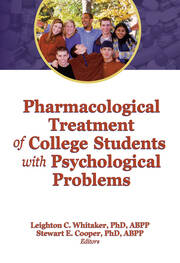

1st Edition
Pharmacological Treatment of College Students with Psychological Problems
- About the Contributors
- Foreword (Thomas L. Murray, Jr.)
- Preface
- PART I: ISSUES AND CONCERNS
- Chapter 1. Forces Pushing Prescription Psychotropic Drugs in College Mental Health (Leighton C. Whitaker)
- Chapter 2. The Escalating Use of Medications by College Students: What Are They Telling Us, What Are We Telling Them? (Gerard Fromm)
- Chapter 3. Matters of Substance: Students’ Voices (Gertrude C. Carter)
- Chapter 4. The Current Status of Prescribing Drugs for College Students: A Nascent Science or a SNAFU? (Gerald Amada)
- Chapter 5. Reality Check: What Science Has to Tell Us about Psychiatric Drugs and Their Long-Term Effects (Robert B. Whitaker)
- PART II: MODELS OF EVIDENCE-SUPPORTED CURRENT PRACTICES
- Chapter 6. Combined Psychotherapy/Medication Treatment: The Valpo Model (Stewart E. Cooper)
- Chapter 7. The Pharmacological Treatment of Depression in College Aged Students: Some Principles and Precautions (Howard C. Blue, Louis C. Sanfilippo, and Christopher M. Young)
- Chapter 8. Does Adding Medication to Psychotherapy for Depression Improve or Worsen Outcome? (Bertram P. Karon)
- Chapter 9. Helping Individuals Withdraw from Psychiatric Drugs (David Cohen)
- Chapter 10. The Fall and Rise of Resilience: Prevention and Holistic Treatment of Depression among College Students (Henry C. Emmons)
- PART III: CONCLUSIONS AND RECOMMENDATIONS
- Chapter 11. The Big Picture and What Can Be Done to Improve It (Leighton C. Whitaker and Stewart E. Cooper)
- Index
- Reference Notes Included
Biography
Leighton C. Whitaker, PhD, ABPP, is in private practice and editor of numerous journals. He is a Fellow of the Society for Personality Assessment and of the American College Health Association and was chair of the Association’s mental health section. He has been Associate Professor and Director of Adult Psychology, University of Colorado Health Sciences Center; Professor and Director, University of Massachusetts Mental Health Services; Director of Swarthmore College Psychological Services; and Consultant to the U.S. Department of Labor’s Job Corps. Dr. Whitaker holds a BA from Swarthmore College and a PhD from Wayne State University, and is a Diplomate in Clinical Psychology from the American Board of Professional Psychology. His 90 professional publications address clinical and social subjects.
Stewart E. Cooper, PhD, ABPP, is Director of Counseling Services and Professor of Psychology at Valparaiso University. He hold Diplomates from the American Board of Professional Psychology in both Counseling Psychology and Consulting Psychology and is a Fellow of Divisions 17 (Counseling) and 13 (Consulting) of the American Psychological Association. Dr. Cooper’s research has focused on the application of multivariate perspectives and methods in diverse counseling-psychology topics. He has published articles, book chapters, and monographs on prevention, psychometric analysis, substance abuse, dual-career issues, organizational consultation, and sex therapy. Most of this scholarship has been on the college population and college mental health issues. He has authored over 50 articles in scholarly journals.
"This is a long-overdue, comprehensive, cutting-edge source book for university counseling center professionals, psychotherapists in other settings, and psychiatrists interested in the collaborative treatment of college-aged students with emotional issues. Anyone interested in learning the true effectiveness/ineffectiveness balance in the use of psychiatric drugs minus the propaganda produced by the pharmaceutical industry should read this book. The work is balanced and extremely useful for anyone in the helping professions."
-Lloyd Ross, PhD, FACAPP, PA in Ethical Human Psychology and Psychiatry, Volume 10, Number 1, 2008
