





1st Edition
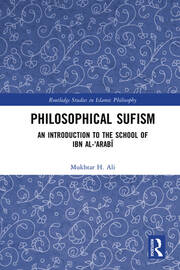
Philosophical Sufism An Introduction to the School of Ibn al-'Arabi
1. Ontology
2. The Divine Names and Attributes
3. Divine Knowledge
4. The Origin of Multiplicity
5. The Universal Worlds
6. The Imaginal World
7. Unveiling
8. The Human Vicegerency
9. The Existential Circle
10. The Supreme Spirit in the Microcosm
11. Prophethood, Messengership and Sainthood
12. Resurrection
Conclusion
Bibliography
Biography
Mukhtar H. Ali is a Research Fellow at the Warburg Institute, School of Advanced Studies, University of London. He specializes in Sufism, Islamic philosophy and ethics, and has published widely in various peer-reviewed venues. He has also translated several works in classical and contemporary Islamic metaphysics, which include The Principles of Correspondences (2013) and The New Creation (2018) and The Horizons of Being: The Metaphysics of Ibn al-ʿArabī in the Muqaddimat al-Qayṣarī (2020).
“Mukhtar Ali's Philosophical Sufism is his second major contribution to analyzing the intersection between the two disciplines, written in a clear and accessible language and deserving a wide readership. Having supervised his dissertation some years ago, I am gratified to see that he has emerged as a prominent scholar in this field of Islamic Studies.”— Hamid Algar, Professor Emeritus of Persian and Islamic Studies, University of California, Berkeley
“Exceptionally clear and clearly exceptional, Philosophical Sufism presents us with an analytically rigorous and spiritually sensitive explication of the main doctrines of the school of Ibn al-ʿArabī, which dominated spiritual and intellectual life in the pre-modern and early modern Islamic world for well over six hundred years. As such, this book recommends itself to not only intellectual historians and professional philosophers, but also those who would like to bring the riches of the Sufi metaphysical tradition to bear upon the impoverished scene of contemporary Islamic thought.”— Mohammed Rustom, author of Inrushes of the Heart: The Sufi Philosophy of ʿAyn al-Quḍāt
“Philosophical Sufism is a very welcome addition to Islamic studies. Mukhtar Ali’s presentation of the intersections of philosophy and Sufism manages to maintain a balance that is wide-ranging, yet structured; accessible, yet profound. Lucidly written, with careful treatments of the key authors and texts of this important intellectual phenomenon, Philosophical Sufism will be invaluable for both researchers and instructors.”— Cyrus Ali Zargar, author of The Polished Mirror: Storytelling and the Pursuit of Virtue in Islamic Philosophy and Sufism.
“Philosophical Sufism offers a highly accessible account of Islamic mysticism in the language of ratiocination. Undergraduates and adepts alike will benefit from the overview of Sufi themes and scholarly literature. Its pedagogical value lies in the clarity of discussion, the author’s effortless style and firm grasp of the topics. An indispensable contribution that bridges the gap between Islamic philosophy and mysticism.”— Harun Rasiah, Associate Professor of Ethnic Studies, California State University
“With skillful erudition, Mukhtar Ali distills the central philosophical tenets of the school of Ibn al-ʿArabi, systematically covering ontology, epistemology, teleology, human vicegerency, the nature of imagination, and the relation between the macrocosm and microcosm. As one of very few introductory texts on the subject, it will prove invaluable particularly to students.”—Atif Khalil, author of Repentance and the Return to God: Tawba in Early Sufism
