




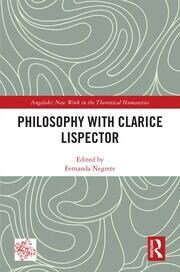

Introduction: Philosophy with Clarice Lispector
Fernanda Negrete
I. Apprenticeships
1. To write is to think [the – is] being
Marcia Sá Cavalcante Schuback
2. Tracing an ethics of risk with Clarice Lispector
Fernanda Negrete
3. Lispector’s halo: Life contemplating itself in The Hour of the Star
Daae Jung and João Paulo Guimarães
II. Subtle Revolutions
4. We are all the smallest woman in the world: Figures of the immanent and the neuter in Clarice Lispector
Luz Horne
5. “When the egg breaks, the chicken bleeds”: Unsettling coloniality through fertility in Lispector’s The Passion According to G.H. and the Chronicles
Rodante van der Waal, Kim Schoof and Aukje van Rooden
6. In the shadows of the cosmos: On the margins of Clarice Lispector’s creative worlds
Tyler Correia
III. Uncommon experiences
7. Affective consisting in Lispector’s An Apprenticeship or The Book of Pleasures
Irving Goh
8. “To Enter the Core of Death”: Listening to the Rhythm of Death in Água Viva and The Passion According to G.H. alongside the Psychoanalytic Clinic
Marta Aleksandrowicz
9. The Failure of Language amidst the Joy of Grace: Reading Lispector’s Água Viva as a Philosophy of (Non)religious Insight
Colby Dickinson
IV. On the Edge of Thought
10. All of Nothing: “Dishumanization” in Lispector and Heidegger
Krzysztof Ziarek
11. Clarice Lispector’s Philosophy of Time
Paula Marchesini
12. “Could it be that what I write to you is behind thought?” (Dialogue with Água Viva by Clarice Lispector)
Jean-Luc Nancy
Biography
Fernanda Negrete is the author of The Aesthetic Clinic: Feminine Sublimation in Contemporary Writing, Psychoanalysis, and Art (2020). She directs the University at Buffalo’s Center for the Study of Psychoanalysis & Culture and coedits its journal Penumbr(a). She coedited Beckett beyond Words (Samuel Beckett Today/aujourd’hui 30.2).
