





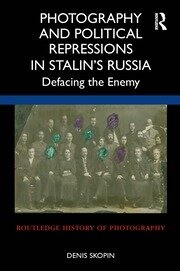
1st Edition
Photography and Political Repressions in Stalin’s Russia Defacing the Enemy
Biography
Denis Skopin is Associate Professor at the Faculty of Liberal Arts and Sciences at Saint Petersburg State University, Russia.
"The book ... is a conceptually and empirically rich study of a corpus of 57 photographs from Stalinist Russia (many of them from Memorial’s archives), in which faces of people declared “enemies of the state” have been removed: scratched out, painted over or otherwise excised. While the existence of such photographs is well known..., Skopin is the first to probe this practice for what it reveals about both Soviet history and the ontology of photography — group photography in particular."
--History News Network
"While delving into the possibly deeper psychological aspects of things, Skopin focuses on the self-preservation instincts of those who manipulated the given photographs, who were driven by the need to find out not only who is and is not the enemy in the photograph, but also where the boundaries between these incompatible worlds lay within their own minds. He shows how this level of highly personal and intimate consideration is different from the more general level of censorship/self-censorship or cultural barbarism/vandalism. He deserves great credit for inviting us to travel to these depths, and for the sensitivity he showed along the way."
--The Russian Review
