




1st Edition
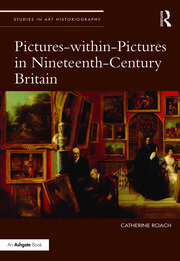
Pictures-within-Pictures in Nineteenth-Century Britain
Contents
List of Figures ix
List of Plates xiii
Acknowledgments xvi
Introduction: Pictures-within-Pictures, an Eighteenth-Century Legacy
1 Creating from Copies: John Scarlett Davis and the British Institution, 1829–1830
2 Outshining the Masters: J.M.W. Turner, Inheritance, and Petworth, 1827–1852
3 Painting Anew: John Everett Millais, Portraiture, and the Pre-Raphaelite Challenge, 1850–1874
4 Claiming Legitimacy: Emma Brownlow King, William Hogarth, and the Foundling Hospital, 1858–1868
5 Critiquing the Critic: W.P. Frith, Oscar Wilde, and Aestheticism at the Royal Academy, 1853–1883
Conclusion: Edouard Manet, William Orpen, and Continental Pictures-within-Pictures
Bibliography
Index
Biography
Catherine Roach is an Assistant Professor of Art History at Virginia Commonwealth University.
Winner of the Historians of British Art Book Prize for a single-authored book with a subject after 1800!
'Pictures-within-Pictures is a smart, impressively-researched, and rich series of readings of individual paintings that opens up into a thought-provoking discussion of how visual citation and recognition functioned for Victorian artists and viewers, and how such references forged new identities for viewers and audiences in specific exhibition venues.'
--Pamela Fletcher, Bowdoin College
'Catherine Roach has written a fascinating account of an equally fascinating genre that has largely escaped scholarly attention .... As Roach points out in this excellent, innovative study, in reproducing other artists' works, painters made those works their own, appropriating them to comment on on array of moral, social and art world topics and (hopefully) their own place in the canon.'
--Julie Codell, Visual Culture in Britain
'Catherine Roach’s Pictures-within-Pictures in Nineteenth-Century Britain announces its quirky theme in its title: paintings that appear within paintings. Such pictures provide a guilty pleasure for the art historian, providing—in Roach’s words—"the delighted surprise that comes from identifying an image from memory and seeing it made strange" (19). Yet Roach’s book demonstrates that this is not just an art-historical gimmick or a simple riddle. Rather, through such pictures, artists make significant statements about art and nationhood, and propose their own art histories.'
--Andrea Korda, caa.reviews
