





1st Edition
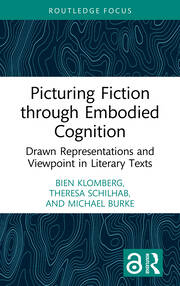
Picturing Fiction through Embodied Cognition Drawn Representations and Viewpoint in Literary Texts
Acknowledgements
Chapter 1 Introduction
Chapter 2 The Theoretical Framework
Chapter 3 The Study
Chapter 4 Embodied Cognition and Point of View
Chapter 5 Discussion and Conclusion
References
Index
Biography
Bien Klomberg is a PhD candidate in the Department of Communication and Cognition at Tilburg University, the Netherlands. Her research focuses on conceptual blending and the comprehension of (dis)continuity in visual narrative sequences.
Theresa Schilhab is Associate Professor in Cognitive Biology at Danish School of Education (Aarhus University), Copenhagen, Denmark. In 2016 she achieved the higher doctorate (doctor pædagogiæ) in Educational Neuroscience on the monograph Derived Embodiment in Abstract Language (2017), which focuses on the biological perspective on language, and is co-editor of the anthology The Materiality of Reading (with S. Walker, 2020).
Michael Burke is Professor of Rhetoric at University College Roosevelt (Utrecht University), Middelburg, the Netherlands. He is the author of Literary Reading, Cognition and Emotion: An Exploration of the Oceanic Mind (2011) and the co-editor of Cognitive Literary Science: Dialogues between Literature and Cognition (with E. T. Troscianko, 2017).
