



1st Edition
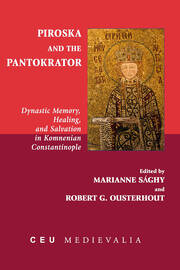
Piroska and the Pantokrator Dynastic Memory, Healing and Salvation in Komnenian Constantinople
360 Pages
by
Central European University Press
This book is about the Christ Pantokrator, an imposing monumental complex serving monastic, dynastic, medical and social purposes in Constantinople, founded by Emperor John II Komnenos and Empress Piroska-Eirene in 1118. Now called the Zeyrek Mosque, the second largest Byzantine religious edifice after Hagia Sophia still standing in Istanbul represents the most remarkable architectural and the... Read more
List of Illustrations, Preface, Introduction, Greek Monasteries in Early Árpádian Hungary, What did Piroska see at Home? New Trends in Art and Architecture in the Kingdom of Hungary around 1100, Diplomatic Relations between Hungary and Byzantium in the Eleventh-Twelfth Centuries, Piroska-Eirene and the Komnenian Dynasty, Komnenian Empresses: From Powerful Mothers to Pious Wives, Piroska-Eirene, First Western Empress of Byzantium: Power and Perception, The Many Faces of Piroska-Eirene in Visual and Material Culture, Imperial Women and Religious Foundations in Constantinople, To Each According to their Need: Medical and Charitable Institutions in the Pantokrator Monastery, Piroska and the Pantokrator: Reassessing the Architectural Evidence, Piroska-Eirene and the Holy Theotokos, “A New Mixture of Two Powers:” Nicholas Kallikles and Theodore Prodromos on Empress Eirene, Ritual and Politics in the Pantokrator: A Lament in Two Acts for Eirene’s Son, Postface, Appendix 1 Synaxarion, Appendix 2 Theodoros Prodromos, Epitaph of Empress Eirene, Appendix 3 Nicholas Kallikles, On the tomb of the Despina
Biography
Marianne Sághy was Associate Professor at the Department of Medieval Studies, Central European University, and at the Department of Medieval and Early Modern Universal History, Eötvös Loránd University, Budapest.
Robert G. Ousterhout is Professor Emeritus in the History of Art at the University of Pennsylvania.
