




1st Edition
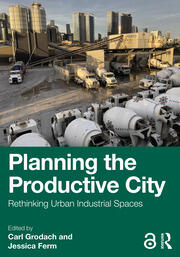
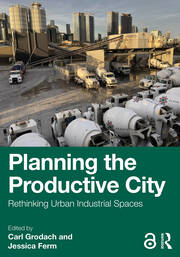
Planning the Productive City Rethinking Urban Industrial Spaces
1. Introduction: Planning the Productive City
Carl Grodach and Jessica Ferm
Part I: Evolving Planning Approaches and Visions of Industrial Lands
2. Two Steps Forward, One Step Back? Adaptation in Regional Industrial Land Preservation
Karen Chapple and Laura Schmahmann
3. Regional Planning for Industrial Land Use: The Case of Portland, Oregon (United States)
Greg Schrock and Jamaal Green
4. Production Activities and Spaces Within the Ecological Transition in Italy: Approaches, Visions, and Challenges in Industrial Land Use Planning
Stefano Di Vita and Yonn Dierwechter
5. From the City of Dreadful Night to MedTech and Microbrews: Evolving Planning Imaginaries of the Industrial City
Carl Grodach, Joe Hurley, Liz Taylor, and Hugh Stanford
Part II: Industrial Policies and Land Use Conflicts
6. Urban Industrial Districts, Property Market Displacements, and "Clusters of Last Resort"
Chris Gibson, Carl Grodach, Craig Lyons, Alexandra Crosby, and Chris Brennan-Horley
7. New Industrial Policies, Old Inequalities: The Case of Chicago’s Lincoln Yards
Winifred Curran, Andrea Craft, and Rachel Weber
8. From Industrial Areas to Industrious Neighborhoods: Examining the London Model
Jessica Ferm and Francis Moss
9. Resisting Industrial Displacement and Gentrification: Insights from Germany
Sabine Baumgart, Stefan Gartner, Holger Hoffschroer, Kerstin Meyer, Johanna Schoppengerd, Lars Sievers, Anne Sofker-Rieniets, and Irene Wiese von Ofen
Part III: Transformations in Industrial Economies and Spaces
10. What Does the Growth of E-Commerce Mean for the Future of Industrial Lands?
Laura Schmahmann
11. Cultural Manufacturing Resilience in Seoul’s Seongsu Neighborhood: Urban Industrial Transformation and Survival Tactics
Heidi Youngha Cho and Dongwoo Yim
12. Making the Future of the City: Insights and Lessons from Athens and Rotterdam
Younghyun Kim, Amanda Brandellero, and Karel Van den Berghe
13. Finding Space for Industries: Clustering Patterns and Building Typologies of Urban Manufacturing in Munich and Stuttgart
Grace Abou Jaoude, Deepank Verma, and Vanessa Miriam Carlow
14. Dialectics of Urban and Peri-Urban Industries: An Explorative Analysis of the Turkish Context
E. Merve Nalcakar and Olgu Calışkan
Part IV: Labor, Skills, and Learning
15. Made with Equity: Inclusive Innovation in Urban Manufacturing
Sophie Kelmenson, Tanu Kumar, Nichola Lowe, and Katy Stanton
16. Educational and Technology Campuses in Industrial Parks
Tali Hatuka and Gili Inbar
17. Walk and Talk Perspectives on Productive Lands: Advocating for Industrial Lands Through Jane’s Walk Experiences
Robin A. Chang, Louise Schwarz, Pooja Thatte, and Liam Cormack
18. A Labor Perspective on the Productive City: The Case of Hamerkwartier in Amsterdam
Tanja Potežica
Part V: Urban Industry and the Climate Imperative
19. Bluing the Green: Nurturing Manufacturing as Green City Strategy
Mark Pendras and Yonn Dierwechter
20. Fixed in the City: Accessibility of Different Types of Repair in London and Amsterdam
Jane Clossick and Birgit Hausleitner
21. The Shape of Urban Industry in a Regenerative Economy: An Adaptation Scenario for Medium-Sized Cities
Claudia Faraone, Francesca Gambarotto, Luca Nicoletto, and Giulio Pedrini
22. Making Space for Construction Companies in a Context of No Net Land Take: The Case of Flanders, Belgium
Sarah De Boeck, Jan Zaman, and Irina Grcheva
Biography
Carl Grodach is Foundation Professor of Urban Planning and Design at Monash University, Australia. His research focuses on economic development and land use planning in relation to urban manufacturing, industrial lands, cultural industries, and circular economies.
Jessica Ferm is Associate Professor in Planning and Urban Economies at the Bartlett School of Planning, University College London, UK. Her research expertise is in the planning and governance of diverse and inclusive economies, and she has published widely on industrial land use planning, sustainable urban manufacturing, and affordable workspace.
“Planning the Productive City: Rethinking Urban Industrial Spaces asks how after decades of being ignored manufacturing can be reintegrated into urban economic development strategies. The rich European and U.S. cases presented in this edited volume examine how cities deemphasized manufacturing – mostly to their peril – and how many are prioritizing industry and industrial land to create new economic activity. The book is a hopeful examination of how manufacturing still matters.”
Joan Fitzgerald, Professor of Public Policy and Urban Affairs, Northeastern University
“Cities once produced things, which helped to grow ideas and the economy. Great cities now live off an economy of ideas and don’t know how or where things are produced. Without spaces for production, cities cannot eat, be sanitized, build, move, or grow. Through making things, materials have knowledge, ideas are grounded, and waste is just a resource. This book brings together an excellent collection of insights from across the world, on how cities can make place for production.”
Adrian Hill, Director, Osmos Network and Cities of Making
"This book debuts with a relevance that the editors and contributors could not have foreseen. Well over half of the world’s population (4.4 billion) lives in urban areas. The global economy’s ability to meet this population’s needs requires high functioning international supply chains. In turn, urban industrial spaces are essential inputs to these supply chains. This is especially the case when global politics are disrupting supply chains. The authors' contributions to this book give us greater and much needed understanding for creating productive industrial spaces that support and improve urban global population conditions."
Nancey Green Leigh, Professor Emerita, School of City and Regional Planning, Georgia Institute of Technology
