





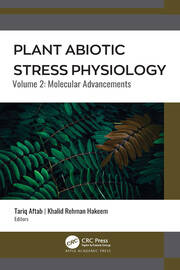
1st Edition
Plant Abiotic Stress Physiology Volume 2: Molecular Advancements
1. Plant-Environment Interaction in Developing Crop Species Resilient to Climate Change
Subhash, Indu, Jyoti Chauhan, Basant Kumar, Vivek Kumar, Prjjal Dey, Udit Nandan Mishra, Chandrasekhar Sahu, and Rajesh Kumar Singhal
2. Genomics Approaches to Study Abiotic Stress Tolerance in Plants
Ahmed H. El-Sappah, M. M. Islam, and Shabir A. Rather
3. Role of Phenomics in Screening Abiotic Stress Tolerance in Plants
Aditya Banerjee and Aryadeep Roychoudhury
4. Genetic Regulation, Biosynthesis, and the Roles of Osmoprotective Compounds in Abiotic Stress Tolerance in Plants
Akbar Hossain, Md. Abu Syedb, Sagar Maitrac, Sourav Garaid; Mousumi Mondale, Md. Babul Akterf, Muzahid E Rahmana, Md. Nur Alama, Mst. Tanjina Islamg, Milan Skalickyh, I. Marian Brestich, and Tofazzal Hossainj
5. Plant Growth Regulators and Their Interaction with Abiotic Stress Factors
Lubna Tariq, Basharat Ahmad Bhat, Syed Suhail Hamdani, Showkat Nissar, Bashir Ahmad Sheikh, Manzoor Ahmad Dar, Safiya Mehraj, and Tanvir Ul Hasan Dar
6. Role of Abscisic Acid in Abiotic Stress Condition and Its Management
Muhammad Muzammal Aslam, Muhammad Ashar Ayub, Zahoor Ahmad, Rana Muhammad Sabir Tariq, Zia Ur Rahman Farooqi, Muhammad Naveed Arshad, and Faiz Ur Rehman
7. Management of Abiotic Stress Conditions by Salicylic Acid
Rana Muhammad Sabir Tariq, Tanveer Ahmad, Muhammad Ashar Ayub, Waqas Ahmad Dogar, Zahoor Ahmad, and Muhammad Muzammal Aslam
8. Ethylene Signaling During Leaf Senescence
Sabeera Muzzaffar, Sajad A. Rather, and F. A. Masoodi
9. Role of in Mitigating Plant Stress and Its Interaction with Salicylic Acid
Basharat Ahmad Bhat, Lubna Tariq, Showkat Nissar, Syed Suhail Hamdani, Manzoor Ahmad Dar, Safiya Mehraj, and Tanvir Ul Hasan Dar
10. Harnessing the CRISPR/CAS System for Resistance Against Abiotic Stresses in Rice: Recent Advances, Applications, Challenges, and Prospects
Shakeel Ahmad, Amina Nisar, Shakra Jamil, Rahil Shahzad, Zhonghua Sheng, Muhammad Munir Iqbal, Chen Wei, Shikai Hu, Luo Ju, Xiangjin Wei, Peisong Hu, and Shaoqing Tang
11. Emerging Roles of Osmoprotectants in the Abiotic Stress Tolerance of Plants
Jeet Ram Choudhary, Showkat Ahmad Ganie, Monika Bansal, Bhavna Goswami, Anita Burdak, Sonu Get, Anurag Tripathi, and Shabir Hussain Wani
Biography
Tariq Aftab, PhD, is currently an Assistant Professor in the Department of Botany at Aligarh Muslim University, India, where he earned his PhD. He is the recipient of a prestigious Leibniz-DAAD fellowship from Germany, a Raman Fellowship from the Government of India, and a Young Scientist Awards from the State Government of Uttar Pradesh (India) and Government of India. After completing his doctorate, he worked as Research Fellow at the National Bureau of Plant Genetic Resources, New Delhi, and as Postdoctorate Fellow at Jamia Hamdard, New Delhi, India. Dr. Aftab was also a Visiting Scientist at the Leibniz Institute of Plant Genetics and Crop Plant Research (IPK), Gatersleben, Germany, and in the Department of Plant Biology, Michigan State University, USA. He is a member of various scientific associations from India and abroad. He has edited seven books with with international publishers, including Elsevier Inc., Springer Nature and CRC Press (Taylor & Francis Group); co-authored several book chapters, and has published over 60 research papers in peer-reviewed international journals. His research interests include physiological, proteomic, and molecular studies on medicinal and aromatic plants.
Khalid Rehman Hakeem, PhD, is Professor at King Abdulaziz University, Jeddah, Saudi Arabia. After completing his doctorate (botany; specialization in plant eco-physiology and molecular biology) from Jamia Hamdard, New Delhi, India, he worked as a lecturer at the University of Kashmir, Srinagar, India, at Universiti Putra Malaysia, Selangor, Malaysia, he was a Postdoctorate Fellow and Fellow Researcher (Associate Professor) for several years. Dr. Hakeem has more than 10 years of teaching and research experience in plant eco-physiology, biotechnology and molecular biology, medicinal plant research, plant-microbe-soil interactions, as well as in environmental studies. He is the recipient of several fellowships at both national and international levels. He has served as a visiting scientist at Jinan University, Guangzhou, China. Currently, he is involved with a number of international research projects with different government organizations. To date, Dr. Hakeem has authored and edited more than 60 books with international publishers. He also has to his credit more than 115 research publications in peer-reviewed international journals and 55 book chapters in edited volumes with international publishers. At present, Dr. Hakeem serves as an editorial board member and reviewer for several high-impact international scientific journals. He is included in the advisory board of Cambridge Scholars Publishing, UK. He is also a fellow of the Plantae group of the American Society of Plant Biologists, member of the World Academy of Sciences, member of the International Society for Development and Sustainability, Japan, and member of the Asian Federation of Biotechnology, Korea.
