




1st Edition
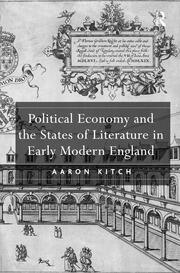
Political Economy and the States of Literature in Early Modern England
By Aaron Kitch
Copyright 2009
228 Pages
by
Routledge
228 Pages
by
Routledge
228 Pages
by
Routledge
Also available as eBook on:
Crossing the disciplinary borders between political, religious, and economic history, Aaron Kitch's innovative new study demonstrates how sixteenth-century treatises and debates about trade influenced early modern English literature by shaping key formal and aesthetic concerns of authors between 1580 and 1630. The author's analysis concentrates on a commonly overlooked period of economic... Read more
Introduction; 1: Spenser and the “Right Vsaunce” of Wealth; 2: Love's Exchequer, or The Uses of Pleasure in the English Epyllion; 3: Fishing for Gold; 4: Shylock's “Sacred Nation”; 5: Character, Credit, and Belief in Middleton's City Comedies; 6: Britain's Burse; Conclusion
Biography
Aaron Kitch is Assistant Professor of English at Bowdoin College, USA.
'Much of the historicist criticism of the past few decades has ignored the shaping influence that an emerging discourse of trade exercised on the literature of early modern England. Political Economy and the States of Literature in Early Modern England seeks to address that oversight by demonstrating that subjects like commerce and credit are treated thoughtfully by a range of canonical authors writing between 1570 and 1620, including Spenser, Shakespeare, Marlowe, Middleton, and Jonson. Rather than interpreting these texts as evidence of the transition from feudalism to capitalism as a Marxist critic might, or invoking a catch-all abstraction like "social energy" as a New Historicist might, Kitch draws on his impressive reading in a range of subjects - from the herring fisheries to bills of exchange - to interpret the economic metaphors and assumptions of early modern authors in light of the local economic contexts that he carefully reconstructs. By examining a wide range of literary forms, Kitch also invites us to ask whether we can speak of the distinct economic values of particular genres like comedy or epyllion.' Blair Hoxby, author of Mammon's Music: Literature and Economics in the Age of Milton ’Kitch’s study is uniquely immersive and, for the careful reader, undoubtedly holds treasures.’ Review of English Studies ’The strengths of Political Economy and the States of Literature are many. It is well reasoned, carefully detailed, and deeply learned: Kitch has read widely within late seventeenth-century economic theory and this learning is evident throughout his analysis. ...Kitch demonstrates the existence of a substantive body of late sixteenth-century texts addressing questions of political economy; by bringing these works to bear upon the period’s literature, our understanding of both literary texts and economic thought is deepened and enriched.’ Sixteenth Century Journal
