





1st Edition
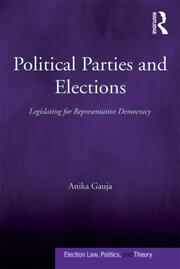
Political Parties and Elections Legislating for Representative Democracy
By Anika Gauja
Copyright 2010
246 Pages
by
Routledge
246 Pages
by
Routledge
246 Pages
by
Routledge
Also available as eBook on:
Political Parties and Elections presents a comparative analysis of the ways in which advanced industrial democracies seek to regulate the activities of political parties in electoral contests. Actual political practice suggests that parties are crucial actors in democratic elections, yet the nature and extent to which parties are regulated, or even recognized, as participants in the electoral... Read more
Chapter 1 Public Law, Political Parties and Representative Democracy: A Framework for Comparative Analysis; Chapter 2 Political Parties and Constitutions; Chapter 3 The Gradual Legal Recognition of Political Parties; Chapter 4 Requirements for Party Registration and Internal Organization; Chapter 5 Regulating Party Candidate Selection Contests; Chapter 6 Parties and the Conduct of Elections; Chapter 7 The Public Funding of Election Campaigns and Political Parties; Chapter 8 The Private Funding of Election Campaigns: Regulating Political Donations and Expenditures; Chapter 9 Parties in Parliament: The Independence of the Legislature; Chapter 10 Conclusion;
Biography
Anika Gauja is a Lecturer in Government and International Relations at the University of Sydney, Australia and holds degrees in Economics and Law from the University of Sydney and a PhD in Politics from Cambridge University, UK. She is the co-author of Powerscape: Contemporary Australian Politics (Allen and Unwin, 2009).
'This is a book that needed to be written. The law in many countries is beginning to catch up with the reality that political parties dominate electoral politics and governance generally. As Anika Gauja ably shows, the regulatory choices taken in response to that fact have important implications for democracy generally.' Andrew Geddis, University of Otago, New Zealand 'This deep and timely work of comparative analysis combines political science learning and legal know-how. Gauja deftly charts the symbiotic relationship of political parties and the regulatory regimes governing them. This book will be of value to anyone interested in the roles played by parties, even outside the common law countries on which it focuses.' Graeme Orr, University of Queensland, Australia
