




1st Edition
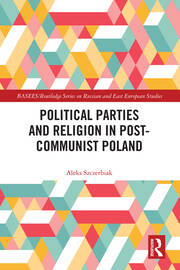
Political Parties and Religion in Post-Communist Poland
Chapter 1 - Introduction
Chapter 2 - A key political actor: The Catholic Church and politics in post-1989 Poland
Chapter 3 - Mobilising Catholicism politically: Explicitly pro-clerical right-wing parties
Chapter 4 - Promoting Catholics values?: The Law and Justice party
Chapter 5 - Flirting with Christian Democracy: Pro-Church right-wing and centrist parties
Chapter 6 - Mobilising anti-clericalism: Anti-Church left-wing and liberal parties
Chapter 7 - Conclusion
Biography
Aleks Szczerbiak is Professor of Politics at the University of Sussex. He is the author of Poland within the European Union: New Awkward Partner or New Heart of Europe? (Routledge, 2012) and Politicising the Communist Past: The Politics of Truth Revelation in Post-Communist Poland (Routledge, 2018).
'Aleks Szczerbiak’s briskly and clearly argued book examines how political parties relate to the Roman Catholic Church and religiosity in Poland. It examines both the broader setting of the Catholic Church in this very religious country, and how political parties operated within this peculiar context, focusing on the right-wing parties whose values aligned with the Church’s.'
Anna Grzymala-Busse, Stanford University, USA'Szczerbiak differs...[from] all other scholars...in his writing the first English-language monograph dedicated to the issue of what he terms the supply side of party politics and religion in post-communist Poland...[He] does this through, among other matters, a thorough empirical study regarding in what manner did political parties in Poland utilize the religious issue with regards to relations with the institutional Church, and or through the religious-secular divide in order to mobilize a desired electorate.'
Christopher Garbowski, Maria Curie-Skłodowska University, Lublin
'Szczerbiak's book is not only a thorough diagnosis of one of the phenomena of Polish politics, but also a successful attempt to depoliticize the language of the debate on this topic. It is undoubtedly a book that is required reading for anyone involved in – or even interested in – Polish politics. Without a religious context, understanding Polish politics, including party politics, is impossible.'
Krzysztof Zuba, University of Opole, Poland (translated from Polish)
