





1st Edition
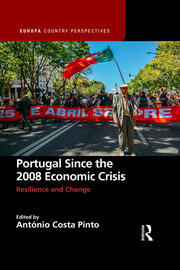
Portugal Since the 2008 Economic Crisis Resilience and Change
Edited By António Costa Pinto
Copyright 2023
300 Pages
18 B/W Illustrations
by
Routledge
300 Pages
18 B/W Illustrations
by
Routledge
300 Pages
18 B/W Illustrations
by
Routledge
Also available as eBook on:
Portuguese democracy is now celebrating its 50th anniversary. Portugal joined the European Union (EU) in 1986, but the enduring legacies of the country’s transition process from authoritarianism to democracy became apparent during the European sovereign debt crisis, when Portugal experienced its third bailout since the institutionalization of democratic government. Although the first decade after... Read more
List of illustrations, The Contributors, Introduction, 1. Portuguese Democracy at 50, 2. European Misfit: The Portuguese Economy after EU Membership, 3. Social Movements and Political Protests in Portugal during and after the Austerity Crisis, 4. European Economic Narratives and the Emergence of a European Public Sphere in Portugal: An Analysis of National Mainstream Newspapers, 5. Presidents and Governments in Portugal: Variations on a Constitutional Theme (2008–2022), 6. Patterns of Ministerial Recruitment, Partisanship and Financial Crisis, 7. Continuity and Change in Portuguese Politics: Towards a more Polarized Party System?, 8. The Populist Radical Right in 21st-Century Portugal, 9. Cultural and Religious Diversity in Portugal, 10. Portuguese Foreign Policy and Crisis Diplomacy in a Period of German Hegemony: Bandwagoning or Soft Balancing?, 11. Portugal’s Role in the EU since 2007: Small State or Equal Partner?, 12. Portuguese Participation in the EU PESCO and NATO as an Interoperability Hub, Index
Biography
António Costa Pinto is a research professor at the Institute of Social Sciences, University of Lisbon and a Professor of Politics at Lusófona University, Portugal. He has been a visiting professor at Stanford University and Georgetown University, USA, a Senior Associate Member at St Anthony's College, Oxford, UK, and a Senior Visiting Fellow at Princeton University and at the University of California, Berkeley, USA. His research interests include authoritarianism, political elites, democratization, and transitional justice in new democracies.
