





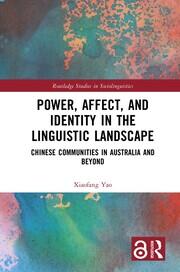
1st Edition
Power, Affect, and Identity in the Linguistic Landscape Chinese Communities in Australia and Beyond
1. Situating power, affect, and identity in the linguistic landscape 2. Theoretical perspectives on the linguistic landscape: Geosemiotics, sociolinguistics of globalisation, and metrolingualism 3. Affect in the linguistic landscape: Conviviality and nostalgia in urban and rural ethnic restaurants 4. Power in the linguistic landscape: Tourism and commodification as revitalisation of cultural heritage 5. Identity in the linguistic landscape: Metrolingualism at the online-offline nexus 6. Artificial Intelligence (AI) in the linguistic landscape: An agenda for critical digital literacy 7. Transcending boundaries in the linguistic landscape: Towards collaborative, participatory, and empowering research
Biography
Xiaofang Yao is Assistant Professor at the University of Hong Kong. Her research interests include linguistic and semiotic landscapes, multilingualism, and digital humanities. She particularly focuses on the intersection of language, culture, and space as they relate to the Chinese diaspora and ethnic minorities.
“The book makes a significant contribution to linguistic landscape (LL) scholarship by presenting an empirically informed account of heterogeneity within the Chinese diaspora in Australia. It advances the field by conceptualising linguistic landscapes as dynamic sites where power, affect, and identity are produced through material, spatial, and semiotic practices across public and digital domains, thereby extending LL research into the lived realities of diasporic experience.”
- Shaitan Alexandra, Chuo University, BAAL News Issue 127 Spring 2026, p.36-37
“Through rigorous ethnography and bold theorisation, Yao offers a study that will influence linguistic landscape research for years to come and serve as a key reference for those interested in the semiotics of place in a posthuman era”
- Ge Song, The Education University of Hong Kong, Journal of Asia Pacific Communication
“[T]he book effectively bridges theoretical insights and empirical research by demonstrating nuanced approaches to analysing signs through the lenses of the three sociolinguistic factors”
- Yuxuan Mu, University of South Florida, Journal of Multilingual and Multicultural Development
“Throughout the book, Yao’s sensitive treatment of the heterogeneity within the Chinese community demonstrates the strength of her insider perspective and critical transnational approach.”
- Ashley Wenjing Xing, Linguistic Landscape: An International Journal
