



1st Edition
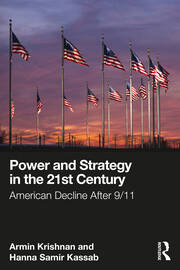
Power and Strategy in the 21st Century American Decline After 9/11
1. Introduction 2. Europe and Russia 3. Middle East 4. East Asia and the Pacific 5. South and Central Asia 6. Canada and Latin America 7. Africa 8. Conclusion: Mapping American Decline
Biography
Armin Krishnan is an Associate Professor of Security Studies at East Carolina University, where he teaches courses on international security, American foreign policy, and intelligence studies. His most recent publications are Havana Syndrome: The Threat to National Security (Bloomsbury 2025) and Fifth Generation Warfare: Dominating the Human Domain (Routledge 2024). His previous research included books on military contracting, autonomous weapons, and military neuroscience. He has published in the Brown Journal of World Affairs, Intelligence and National Security, Contemporary Security Policy, and the Journal of Strategic Security.
Hanna Samir Kassab is an Associate Professor of Political Science and Security Studies at East Carolina University. He teaches courses in national security, foreign policy, and global politics. His most recent books Multipolar Revisionism and Cutting the Cost of American Hegemony: The Long-Run is Here (2026) and Post-Colonial Realism: Cultural Conflicts, Cuisine, and the Changing International System (2025) are published by Routledge. His journal articles include “Mackinder’s Heartland Thesis and the Belt and Road Initiative: Russia’s Growing Dependence on China in the Aftermath of the Ukraine War” in Brazilian Journal of Strategy & International Relations and “Prestige, Humiliation and Saving Face: National Identity and Great Power Politics” in Contemporary Military Challenges.
Few scholars connect the dots between deficit spending, failed wars, and the erosion of American hegemony as effectively as Krishnan and Kassab. Their regional approach reveals how U.S. overextension has played out differently across the globe, making a compelling case that financial recklessness, not just military misadventure, is driving hegemonic decline. Essential reading for international relations scholars
Dr. Orlando J. Pérez, University of North Texas at Dallas
This book offers new alternative perspectives and insights into the decline of US influence globally in relation to Russia and China. It covers every region of the world and explores the competition between the world’s greatest powers: the United States, China, and Russia. Importantly, the book addresses a gap in serious studies of US foreign policy in terms of strategic overstretch and the impacts of escalating national debt, and a weakening currency. This analytical approach is interesting as the financial cost of foreign policy and the central role of the USD in US hegemony is under explored. Overall, a good read which challenges the traditional narrative.
David Baxter, International Development Consultant and Procurement and PPP Navigator
Krishnan and Kassab offer a lucid and insightful analysis of the United States’ future international position and of the implications for the world in the event that American power is in retreat or decline. Their book will be of value to specialists and general readers alike.
Rajan Menon, City College of New York
Krishnan and Kassab explain global power shifts underway with the relative retreat of U.S. power against the augmented global engagement of rising powers. The complex foreign policy landscape – and argument for regional approaches that respect global norms - is well presented in this timely book.
Beverely Barrett, University of Houston
An important book that addresses timely security issues and debates. Highly recommend
Jonathan D. Rosen, New Jersey City University
A timely and ambitious study, this book [or the title of the book] revisits the question of American power through the lens of imperial overstretch. Combining regional analysis with systemic theory, it offers a thought-provoking contribution to debates on global order and great power competition. It highlights the uneven, heterogeneous, and increasingly multipolar dynamics shaping contemporary international politics
Dr Eduard Abrahamyan, University College London
