




1st Edition
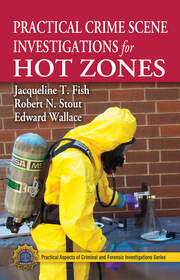
Practical Crime Scene Investigations for Hot Zones
The Need
References
The Threats
Chemical
Biological
Radiological
Nuclear
References
Laws and Regulations
Introduction
Part I: Training and Response
Part II: Weapons of Mass Destruction Statutes
Court Documents
The Protection
Definitions
Hazards
Respiratory Protection
Chemical Protective Clothing (CPC)
The Differences
The Equipment
Safety
Documentation Equipment
Recon Equipment
Evidence Recovery Equipment
Evidence Collection and Packaging Support Equipment
Equipment for Evidence/Equipment Decontamination
The Personnel (Members)
The CBRNE/TIC Crime Scene Investigation Unit
CBRNE/TIC CSIU Components
Roles and Responsibilities of the Command Staff
Roles and Responsibilities of the Operational Staff
The Recon
The Documentation
The Screening
Asceptic Techniques
Collection, Processing, and Packaging of CBRNE/TIC Evidence
Collection Protocols
Protocol for Visible Suspected Chemical Liquid Residue on Nonporous and Some Porous Surfaces
Protocol for Suspected Stratified (Layered) Chemical Liquid in a Container
Bulk Powder Protocol, Suspected Biological, on Nonporous and Some Porous Surfaces
Dry Swab Protocol for Visible Powder, Suspected Biological, on Nonporous and Some Porous Surfaces
Wet Swab Protocol for Visible Powder, Suspected Biological,on Nonporous or Porous Surface
Collection, Processing, and Packaging of Forensic Evidence
Latent Fingerprints
Hair/Fiber Evidence
DNA Evidence
Trace Evidence
Impression Evidence
Footwear, Tire, Tool/Weapon, Ballistic, and Bite
Impression Evidence
Decontamination
Types of Decontamination
The Crime Scene Wrap-Up
Search Entry Operations
Final Survey Operations
Final Briefing
Appendix A
Homeland Security Presidential Directive/HSPD-5 325
Index
Biography
Jacqueline T. Fish currently serves as chair of the Criminal Justice Department and director of graduate studies in criminal justice at Charleston Southern University. Her career includes development oversight of the National Forensic Academy curriculum and seventeen years as a police officer in Knox County, Tennessee, where she invested the majority of her time as sergeant in charge of the Criminal Identification Division.
Robert N. Stout has more than 30 years of experience in law enforcement and hazardous materials. His law enforcement experience includes serving as sergeant for the Virginia State Police, deputy/paramedic for the Amherst County Sheriff’s Office, and in motor carrier safety/hazardous material team/environmental crimes investigations for the Virginia State Police.
Edward W. Wallace, Jr. served with the New York Police Department (NYPD) for more than 20 years and performed various law enforcement duties, including crime scene investigator and counter-terrorism investigator. Mr. Wallace held the coveted NYPD rank of Detective First Grade and spent 15 years in crime scene investigations, where he investigated numerous high profile crimes, including participating in the investigations of both World Trade Center attacks and the October 2001 anthrax attack. Mr. Wallace lead the development of the national curriculum of crime scene investigations for CBRNE/TICs for the National Center of Biomedical Research and Development at Louisiana State University and the U.S. Department of Homeland Security.
