





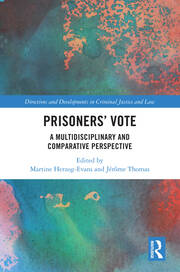
1st Edition
Prisoners' Vote A Multidisciplinary and Comparative Perspective
Introduction
Martine Herzog-Evans and Jérôme Thomas
PART 1 - Can Prisoners Vote?
Waking Up to Re-enfranchisement
Chapter 1 - Prisoner Voting Rights and International law
Steve Foster
Chapter 2 - Incarcerated Individuals’ Right to Vote in the Czech Republic
Petra Zhrivalova and Tereza Trebjalova
Chapter 3 - Criminal Disenfranchisement in Old Democracies: Comparing France, the UK, and, the United States
Alice Dejean de la Batie
PART 2 - Should Prisoners Vote?
Chapter 4 - To Feel Part of a Wider Community: The Case for Prisoner Voting
Cormac Behan
Chapter 5 - US disenfranchisement and Re-enfranchisement explained
Christopher Uggen, Robert Stewart and Emma Lookner
Chapter 6 - Prisoners’ Vote in France: Political Capital, Social Bond, and Desistance
Martine Herzog-Evans and Jérôme Thomas
Chapter 7 - Waking Up to Re-enfranchisement
Fergus McNeill
Biography
Martine Herzon-Evans teaches penology and criminology at the Université de Reims-Champagne Ardennes, France. Her research interests range from legitimacy of justice, sentences, problem-solving courts, offender treatment, prisons and reentry and domestic violence.
Jérôme Thomas is a lecturer in information and communication sciences at the university of Reims Champagne-Ardenne / IUT de Troyes (France). His work focuses on the forms of expression, speech, and communication that occur in institutions of deprivation of liberty and control, such as psychiatric hospitals and prisons.
