




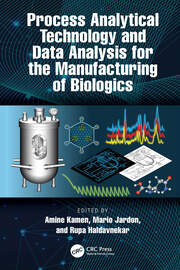
1st Edition
Process Analytical Technology and Data Analysis for the Manufacturing of Biologics
Chapter 1 Introduction: PAT and Digitalization in Pharmaceutical Biomanufacturing
Mario A. Jardon, Amine Kamen, and Rupa Haldavnekar
Chapter 2 The QbD Approach for Manufacturing of Biologics
Ayyappasamy Sudalaiyadum Perumal and Mario A. Jardon
Chapter 3 PAT Tools for Process Monitoring of Biologics Manufacturing
Ayyappasamy Sudalaiyadum Perumal and Malvika Nagrath
Chapter 4 Essential Analytics Framework for PAT Data Analysis
Shawninder Chahal and Xingge Xu
Chapter 5 Application of Machine Learning in PAT
Shawninder Chahal and Xingge Xu
Chapter 6 PAT and Process Control
Xingge Xu, Rupa Haldavnekar, and Malvika Nagrath
Chapter 7 PAT for Process Modelling
Xingge Xu and Shawninder Chahal
Chapter 8 Process Data Management
Javid Jannat and Mathieu Bourgey
Chapter 9 Future Perspectives on Process Analytical Technologies and Data Analytics for Biologics Manufacturing
Rupa Haldavnekar and Amine Kamen
Chapter 10 Case Study: PAT in mRNA–LNP Manufacturing
Laurence Dubeau-Mallette, Julia Puppin Chaves Fulber and Amine A. Kamen
Biography
Prof. Amine Kamen holds the Canada Research Chair in Bioprocessing of Viral Vaccines at McGill University (retired) and is Researcher Emeritus at the National Research Council of Canada. He is a leading expert in bioprocess engineering, specializing in the development and manufacturing of viral vectors for vaccination and gene and cell therapy. His research has significantly advanced scalable production platforms for adenovirus, lentiviral, adeno-associated virus (AAV), and vesicular stomatitis viral (VSV) vectors, with applications in vaccine, CAR-T cell therapy, and gene editing development. His contributions include the development of serum-free suspension cultures using HEK-293SF and VERO cells, enabling high-yield production of clinical-grade viral vectors. Professor Kamen’s work integrates cell culture engineering, process analytical technologies, and quality by design principles to ensure robust and reproducible manufacturing processes. Currently his efforts are directed to advancing mRNA technology for intensification and densification of cost-effective manufacturing processes to enable equitable access. He has authored over 210 peer-reviewed publications and has been instrumental in training the next generation of biomanufacturing professionals through academic and industry collaborations.
Dr. Rupa Haldavnekar is an assistant professor at the University of Oklahoma, School of Electrical and Computer Engineering. She holds a PhD in Biomedical Engineering with focus on surface-enhanced Raman scattering (SERS)–based molecular analysis for cancer diagnosis. Currently Dr. Haldavnekar is developing Raman spectroscopy–based process analytical technology for cancer diagnosis. Her research interests also include the development of orthogonal methods for the investigation of cellular interactions in tumor microenvironment.
Dr. Mario A. Jardon is Faculty Lecturer at the Department of Bioengineering, McGill University. He holds a PhD degree in Chemical and Biological Engineering. He has several years of experience in biopharmaceutical manufacturing. His scientific expertise includes the development and intensification of mammalian cell-based process for recombinant protein production, with a focus on integrating cellular stress responses and metabolism to understand and engineer biological systems responses, with the aim of developing high-performance manufacturing processes used for therapeutic biologics.
