




1st Edition
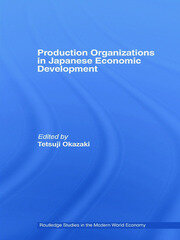
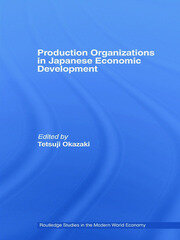
Production Organizations in Japanese Economic Development
By Tetsuji Okazaki
Copyright 2007
272 Pages
26 B/W Illustrations
by
Routledge
272 Pages
26 B/W Illustrations
by
Routledge
272 Pages
by
Routledge
Also available as eBook on:
In this important new book, the authors explore how production was organized in the context of the economic development of modern Japan.
Production organizations are taken to mean the long-term relationships which economic agents create for production, based on employment contracts or long-term transactions. This includes hierarchical organizations such as factories and... Read more
1. Introduction, Tetsuji Okazaki and Masaki Nakabayashi, 2. Transition from putting-out system to factory system, Tomoko Hashino, 3. Formation of the labor market, Ryo Kambayashi, 4. Emergence of modern corporate organization, Naofumi Nakamura, 5. Employment of professional managers: Determinants and implications, Tetsuji Okazaki , 6. New function of putting-out system, Masaki Nakabayashi, 7. Reproduction of flexible production organization, Masayuki Tanimoto, 8. Formation of subcontracting system, Kazuaki Kagami
Biography
Tetsuji Okazaki is at the University of Tokyo
"This is a valuable and timely volume on an important aspect of Japanese economic history that has received relatively little attention in the literature. ... All in all, this is a very solid contribution that showcases some of the best works of a new generation of Japanese economic historians whose works are informed by economic theory and careful archival research. It contributes to fill a gap in the existing literature on Japanese economic history, which has not given adequate attention to the role of small-scale and craft-based industry in Japanese modernization." -- Economic Development and Cultural Change, vol 58, number 3., Debin Ma, London School of Economics
