




1st Edition
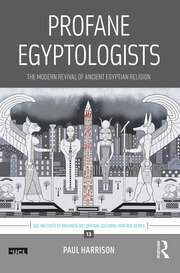
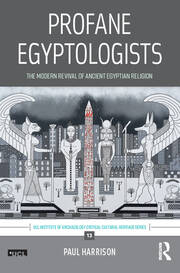
Profane Egyptologists The Modern Revival of Ancient Egyptian Religion
Part I: Why Kemeticism?; 1. Introduction; 2. Estbalishing orthodoxy; 3. Breaking down the doors; Part II: Pharaonic Religion; 4. Power station, people's opiate, or proof of piety?; 5. Faith or decorum? Tracing Amarna upheaval, mourning and mysticism in text and archaeology; Part III: Esoterica and Egyptology; 6. Early encounters; 7. Kemetic Orthodoxy and the House of Netjer; 8. Independent practitioners and splinter movements; 9. Ideologies; 10. Practices; 11. Objects; 12. Discussion: 'contested' resources or continuum?; 13. Conclusion: 'recon'-ceptualising Egypt; Bibliography; Appendix
Biography
Paul Harrison gained an MA and PhD from UCL, where he is an Honorary Lecturer for the Institute of Archaeology. He has appeared on the History Channel and Sky News as an historical expert, and lectured at UCL and the British Museum. His areas of research include Egyptomania, public engagement, political appropriations of the past, spirituality and the occult, and the intersection of history with ethnicity. His recent work focuses on historical communication in print and media. He is currently working on his second book and finishing a documentary based on archaeological conservation.
"Profane Egyptologists is the first monograph-length discussion of the subject, and is the product of a fouryear study conducted as part of Paul Harrison’s Ph.D. research. In this, it is a pioneering and welcome contribution on a poorly understood movement......It is an important work, and it is hoped that its pioneering contribution inspires further research into Kemeticism and to the use of ancient Egypt by modern religious communities more broadly."
Ethan Doyle White, University College London, UK
