




1st Edition
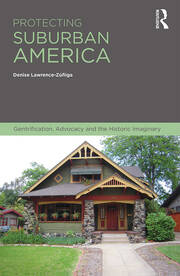
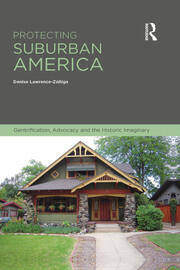
Protecting Suburban America Gentrification, Advocacy and the Historic Imaginary
By Denise Lawrence-Zuniga
Copyright 2016
208 Pages
by
Routledge
208 Pages
by
Routledge
208 Pages
by
Routledge
Also available as eBook on:
Protecting Suburban America explores the dynamics and conflicts inherent in preserving historic twentieth-century suburban landscapes in America.Bridging architecture, anthropology, planning, and urban studies, its unique approach combines a study of historic preservation with multi-sited ethnographic fieldwork, to shed fascinating light on issues of heritage, preservation, gentrification, class,... Read more
1. Introduction: Framing Preservation2. Discovering Material Agency: Making of the Preservation Homeowner3. Restoration Strategies: Imagining the Past and Reconstructing Historic Meaning4. History Preservation Cosmology: Municipal Regulations and City Dynamics5. Local Level Preservation and Exclusion: Traditional Elites6. Gentrification: Education, Reform and Advocacy7. Immigrant Challenges: Communicating Preservation Values Across the Cultural Divide in Alhambra8. Conclusion: Toward an Anthropology of SuburbiaBibliographyIndex
Biography
Denise Lawrence-Zuniga is Professor of Architecture and a sociocultural anthropologist at the College of Environmental Design, California State Polytechnic University, Pomona, USA.
"Protecting Suburban America: Gentrification, Advocacy, and the Historic Imaginary will undoubtedly take a prime spot on the bookshelves of both professional and grassroots preservationists ... as well as public historians, memory scholars, and cultural historians broadly conceived. Indeed, the ethnography alone makes it worthwhile, while the nuanced look at race and power will no doubt spark fruitful discussion among those who read and discuss it. - Heritage & SocietyThis comprehensive study of gentrification in California deftly exposes the persistent linkage between historic conservation and genealogical passion on the one hand and covert forms of social and ethnic exclusion on the other. It is a major contribution to our understanding of an increasingly common form of structural violence as well as of the surprisingly varied motives that drive the passion for the past. - Michael Herzfeld, Ernest E. Monrad Professor of the Social Sciences, Harvard University"
