





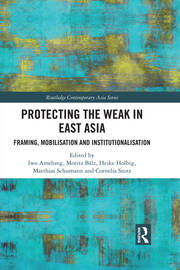
1st Edition
Protecting the Weak in East Asia Framing, Mobilisation and Institutionalisation
1. Introduction, Iwo Amelung, Moritz Bälz, Heike Holbig, Matthias Schumann and Cornelia Storz
Part I: Historical and Conceptual Background Studies
2. Protecting the Weak or Weeding out the Unfit? Disaster Relief, Animal Protection, and the Changing Evaluation of Social Darwinism in Japan and China, Matthias Schumann
3. Processes of Appropriation: Welfare and Cultural Heritage in East Asia, Iwo Amelung
4. Shifting Relations between State and Social Actors: Ambiguous Strategies of Protecting the Weak in Japan and China, Heike Holbig and Moritz Bälz
5. Theories on Institutional Change: An Application to the Dynamics of “Protecting the Weak”, Cornelia Storz and Heike Holbig
Part II: Comparative Studies of Empirical Cases in Contemporary Japan and China
6. From Natural Hazard to Man-Made Disaster: The Protection of Disaster Victims in China and Japan, Elisa Hörhager andJulius Weitzdörfer
7. Employee Well-being in China and Japan: A Media Content Analysis, Markus Heckel, Stefan Hüppe and Na Zou
8. Animal Protection in China and Japan: The Ambiguous Status of Companion Animals in Rapidly Changing Societies, Kazushige Doi & Jean-Baptiste Pettier
9. Protecting the Weak? Tracing UNESCO’s Influence on Intangible Cultural Heritage Regimes in Japan and China, Christina Maags and IoanTrifu
Part III: Conclusions
10. Weak v Strong: Ambiguities of Protection, Iwo Amelung, Moritz Bälz, Heike Holbig, Matthias Schumann and Cornelia Storz
Biography
Iwo Amelung is Professor of Chinese Studies at Goethe-University Frankfurt/Main, Germany.
Moritz Bälz holds the Chair of Japanese Law and its Cultural Foundations at the Goethe University Frankfurt/Main, Germany.
Heike Holbig is Professor of Political Science at Goethe University in Frankfurt/Main and a senior research fellow at the German Institute of Global and Area Studies in Hamburg, Germany.
Matthias Schumann is a postdoctoral research fellow at the International Consortium for Research in the Humanities "Fate, Freedom and Prognostication" at the University of Erlangen-Nürnberg, Germany.
Cornelia Storz is Professor of Economic Institutions, Innovation and East Asian Development at the Goethe University Frankfurt/Main, Germany.
