





1st Edition
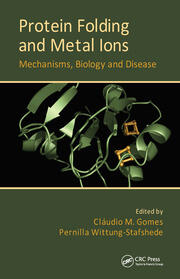
Protein Folding and Metal Ions Mechanisms, Biology and Disease
FOLDING AND STABILITY OF METALLOPROTEINS : Metal Ions, Protein Folding, and Conformational States: An Introduction. The Folding Mechanism of c-Type Cytochromes. The Mechanism of Cytochrome c Folding: Early Events and Kinetic Intermediates. Stability and Folding of Copper-Binding Proteins. Iron-Sulfur Clusters, Protein Folds, and Ferredoxin Stability. Folding and Stability of Myoglobins and Hemoglobins. MECHANISMS OF METAL TRANSPORTERS, AND ASSEMBLY: Frataxin: An Unusual Metal-Binding Protein in Search of a Function. Mechanism of Human Copper Transporter Wilson’s Disease Protein. METAL IONS, PROTEIN CONFORMATION, AND DISEASE: α-Synuclein and Metals.
Zinc and Misfolding. The Octarepeat Domain of the Prion Protein and Its Role in Metal Ion Coordination and Disease. METALLOPROTEIN DESIGN, SIMULATION, AND MODELS: Metallopeptides as Tools to Understand Metalloprotein Folding and Stability. The Folding Landscapes of Metalloproteins.
Biography
Cláudio M. Gomes is group leader at the Instituto Tecnologia Química e Biológica, a research institute affiliated with the Universidade Nova de Lisboa, Oeiras, Portugal. Born in 1970, Cláudio earned his PhD from the Instituto Tecnologia Química e Biológica in 1999, as a Gulbenkian PhD program in biology and medicine graduate. From 2000 onward, he gradually switched his research interests from bioenergetics and metalloprotein structure-function toward protein folding and structural biophysics of misfolding diseases. Until setting up his independent laboratory in 2003, he was assistant professor at the Faculdade de Ciências e Tecnologia, Universidade Nova de Lisboa, where he started teaching in 2000. Cláudio has published more than 70 peer-reviewed papers.
Pernilla Wittung-Stafshede has been a professor in biological chemistry in the Chemistry Department at Umeå University, Umeå, Sweden since 2008. Born in 1968, she earned a PhD in physical chemistry from Chalmers University, Gothenburg, Sweden, in 1996. During 1997–1998, she did a postdoctoral period at Caltech, Pasadena, California. In 1999 she began her independent research career, with a focus on the role of metals in protein folding, as a chemistry professor at Tulane University, New Orleans, Louisiana. After 5 years at Tulane, she moved to Rice University, Houston, Texas in 2004 and became a professor in biochemistry. Pernilla has graduated 10 PhD students to date, has obtained several awards, and has published over 150 peer-reviewed papers.
