




1st Edition
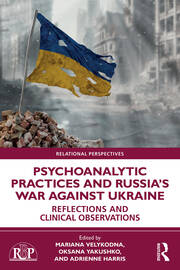
Psychoanalytic Practices and Russia's War Against Ukraine Reflections and Clinical Observations
1. In the Nets of Trauma. Ukrainian Case.
Natalia Nalyvaiko
2. Phenomenology of Psychic Processes and Relationships in Wartime Ukraine
Valeriy Dorozhkin
3. Oedipal conflicts during wartime: War and the infantile fantasies
Yuliia Vizniuk
Elina Yevlanova
Chapter 4. “I do (not) want to kill:” Trauma Beyond Words
Olena Medvedieva
Chapter 5. The mental void: Impact of war on Non-Neurotic Structures
Olga Pavlovska
Nina Kokoilo
6. Psychoanalytic Practice in Wartime Ukraine: Challenges to the Ethics
Oksana Arshevska-Guérin
Natalia Nalyvaiko
Mariana Velykodna
7. Effects and Affects of War in Psychoanalytic Practice
Oleh Khrystenko
8. War-forced terminations of psychoanalysis: cases from Ukraine
Mariana Velykodna
9. Avoiding talking about the war? Features of transference during counseling with Ukrainian refugees
Elina Yevlanova
10. The Crisis of Group Identity during the War: Experience of Working with the Ukrainian Jewish Community
Olena Slobodianiuk
Olena Osypenko
11. The “Severed Roots” People: Psychoanalytic Reflections from Running the Psychological Hotline Work with Ukrainian Refugees
Sergii Ugrium
12. Psychoanalytic therapy with children in the realities of war: an analysis that cannot be
Yelyzaveta Davoian
Daria Kyrylova
Zoia Miroshnyk
13. Wartime Supervision as Psychoanalytical Research of Clinical Cases and Psychic Phenomena
Volodymyr Mamko
14. He. She. War: Transforming War-Related Experience through the Intervision Group Dynamics
Veronika Lukyanova
Ruslana Rudenko
15. International and national psychoanalytic initiatives in wartime Ukraine: history of 2022-2023
Alexander A. Lupis
Marianna Tkalych
Mariana Velykodna
Biography
Mariana Velykodna is a EuroPsy-registered psychologist, psychoanalytic psychotherapist certified by the European Confederation of Psychoanalytic Psychotherapies, an associate professor and Head of Psychoanalytic Psychotherapy Department at Ukraine Sigmund Freud University in Ukraine.
Oksana Yakushko is a licensed psychologist, psychoanalyst, and Ukrainian immigrant. She is a faculty at the George Washington University and a psychoanalytic practitioner in California and Washington, DC.
Adrienne Harris is a faculty and supervisor in the New York University Postdoctoral Program in Psychotherapy and Psychoanalysis, Faculty and Training analyst at the Psychoanalytic Institute of Northern California, and serves on Editorial Boards of several psychoanalytic journals.
‘This book should be required reading for all therapists. Its contributors put words to the unspeakable and bear witness to the unbearable. No human being can fully represent the horrors and continuing psychological depredations of war, and yet these essays manage to capture the precariousness and preciousness of our existence, the power of our feelings about place, and the critical role of our moral center of gravity in the face of evil. With clarity, passion, and brilliance, these authors help us see that although war-adapted psychotherapies can help only in modest ways, they matter profoundly.’
Nancy McWilliams, PhD, ABPP, visiting professor Emerita, Rutgers Graduate School of Applied & Professional Psychology
The urgency of this book, both for those who live under conditions of war and for psychoanalysis itself, cannot be overstated. In this volume’s efforts to un-silence, in real time, the consequences of the ongoing Russian effort to annihilate individuals, culture and country and is a quintessential antidote to war’s dehumanizing force and demanding of us that we embrace the possibilities inherent in our profession. The valuable opportunity this volume provides melds theory, practice and personal experience to expand our clinical, conceptual and moral capacities to counter the violent occupation that so much of our world is seemingly authorized by fascism’s rise to perpetuate. There is a testimony here to the isomorphic interchange between psychic and large-group catastrophe, but there is also, in this series of essays, much hope and inspiration in the authors’ persistence in speaking psychoanalytically-informed truth, to which it behooves us to listen, despite all.
Nancy Burke, PhD, ABPP, clinical professor, Northwestern University; Chicago Center for Psychoanalysis
