




1st Edition
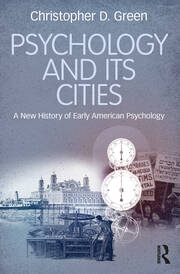
Psychology and Its Cities A New History of Early American Psychology
Introduction
Chapter 1. New York City, Birthplace of William James
Chapter 2. Granville Stanley Hall, the Farmboy goes to Gotham
Chapter 3. William James Comes to Harvard
Chapter 4. James and Hall Meet
Chapter 5. Baltimore and the Johns Hopkins University
Chapter 6. Chicago
Chapter 7. The Formation of Psychology’s "Schools"
Chapter 8. Psychology in New York and Boston in the 1890s
Chapter 9. The Dawn of the 20th Century
Chapter 10. Psychology on the Public Stage
Epilogue
Biography
Christopher D. Green is Professor of Psychology, York University, Canada. He is former President of the Society for the History of Psychology and former editor of the Journal of the History of the Behavioral Sciences.
"Professor Chris Green has given us a richly contextualized history of the early years of the development of American psychology. He weaves together fascinating biographical information with the social histories of New York, Boston/Cambridge, Chicago, and Baltimore to illustrate how key figures were influenced by the settings they lived and worked in. The result is a veritable moveable feast."
—Wade E. Pickren, Ithaca College, USA
"Green’s insightful focus on the ‘socio-economic environment in which American psychology took root’ in the Gilded Age well demonstrates that this milieu ‘was the sea in which psychology swam.’ His book thus presents an exciting new perspective that does make for the ‘New History of American Psychology’ his subtitle promises."
—Michael M. Sokal, Worcester Polytechnic Institute, USA
"Leading historian of psychology Chris Green has written an exceptional and lucid account of the reciprocal influences of late 19th and early 20th century American psychology and its urban settings. This is a refreshing and unusual treatment of disciplinary context too often and easily overlooked."
—Wayne Viney, Colorado State University, USA
"Congratulations! Written with the page-turning, engaging style of a brilliant professional historian, and obsessively footnoted and profusely documented, this book presents a unique and innovative perspective on the profound influences of rapidly changing cities on the development of early American psychology."
—Michael Wertheimer, University of Colorado at Boulder, USA
