





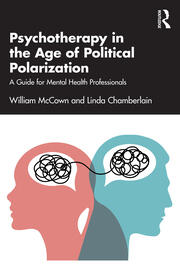
1st Edition
Psychotherapy in the Age of Political Polarization A Guide for Mental Health Professionals
1. The Great Divide 2. Left and Right: Models of Liberal and Conservative Differences 3. Political to Partisan: How We Got Here 4. The Question of Liberal Bliss in Mental Health Professionals 5. Politics Invades the Therapy Space 6. Empathy in Counseling the Politicized Client 7. Partisanship and Grief 8. Complex Disorders and Politics 9. Politics, Substance Abuse, and Addictive Behaviors 10. Working with Political Polarization in Relationships and Families 11. Depolarization, Training, and Support 12. Ethics and Advocacy Appendix A: Political Orientation and Therapeutic Outcomes Appendix B: Resources and Recommended Reading Index
Biography
William McCown, PhD, is a licensed clinical psychologist and professor at the University of Louisiana Monroe, where he has taught for over 30 years and held various administrative roles. He earned his doctorate from Loyola University Chicago and completed a clinical internship at Tulane University Medical Center, specializing in both adult and child psychology. His clinical interests include gambling disorders, motivational problems, and neurodiversities. Much of his research has focused on measuring and treating chronic procrastination and exploring nonlinear systems in human behavior.
Linda Chamberlain, PsyD, is a licensed psychologist and professor (retired) with the Social and Human Services program at Pasco-Hernando State College in New Port Richey, Florida. She has worked as both an educator and clinician in the field of psychology and human services for 50 years. Dr. Chamberlain has authored and edited several books, including Practicing Psychotherapy: Lessons on Helping Patients and Growing as a Professional published in 2021 by Routledge/Taylor & Francis, and has been an invited speaker at local, national, and international conferences. She also serves as the co-moderator of the Mental Health Professionals Forum with Braver Angels.
“Psychotherapy in the Age of Political Polarization: A Guide for Mental Health Professionals is a timely must- read for mental health students and professionals seeking to better understand the contemporary political and social influences on the lives of our clients.”
Zander Keig, NASW, Social Worker of the Year (2020)
“This book addresses a serious issue in the mental health field. Conservatives have a difficult time finding a therapist they can trust. In other contexts, therapists have come to understand that they must be knowledgeable and sensitive to the beliefs and values of their clients. It is time to recognize this is also true of political orientation.”
Paul Norris, LMFT, associate director, Braver Angels Debate Program
“Politics, and the political strife that characterizes contemporary American society, inform clients’ sense of identity, belongingness, and psychological safety. Our clients inevitably bring political issues to the consulting room, not merely as opinions, but as crucibles for defining their world-view and their sense of place and purpose in society. The inherent tension between the fundamental human need for interpersonal connection, versus the rampant and worsening alienation and fragmentation in the body politic, endangers well-being at all levels—family, neighborhood, community, and workplace. Drs. McCown and Chamberlain courageously take on a delicate task: bringing solid research perspectives to bear to illuminate an ethically sensitive and clinically meaningful approach to these issues, with the therapeutic mission and the well- being of the client always in the foreground. This is timely and valuable work, especially but not only for early career clinicians and those in training.”
Jonathan Richard, PsyD, clinical psychologist
“William McCown and Linda Chamberlain brilliantly elucidate how the emotional and psychological impact of deep political divisions may become reflected within the therapy relationship. Demonstrating how political views are deeply rooted in people’s identities and values, they further illustrate how disagreements can fracture the therapeutic alliance, create a breach of trust, or lead to irreparable treatment ruptures. McCown and Chamberlain enrich our understanding of the political divide by offering information and skills that mental health professionals can incorporate into their practices, including the importance of empathy, non-judgment, and communication skills, and fostering a deeper understanding of shared human experiences. The effects of extreme partisanship and its impact on treatment and relationships are certainly not taught to mental health professionals, who inevitably encounter this phenomenon in their practices. Skillfully, sensitively, and intentionally, McCown and Chamberlain guide clinicians to approach rather than avoid or fear issues of political partisanship in their work. Psychotherapy in the Age of Political Polarization is a great learning source for any mental health clinician.”
Mary Lamia, PhD, clinical psychologist, psychoanalyst, professor, author
“The authors stress a fundamental truth: Human beings are more alike than they are unalike, and thus, all have the foundational need to be emotionally healthy. These authors know the ‘social territory’ and how to navigate the present terrain. They offer down-to-earth practical strategies on how to do just that. The case studies help readers to visualize the effectiveness of these strategies and further demonstrate the authors’ collective expertise. A job well done!”
Pamela Higgins Saulsberry, PhD, LCSW- BACS, Professor Emeritus of Social Work, University of Louisiana at Monroe
“Therapists can no longer afford to ignore the sequelae between race, gender, and politics particularly among those existing on the margins of American society (i.e., Blacks, Asians, women, children, LGBTQIA). Political polarization continues to negatively impact these groups at disproportionate rates on a local, state, and national scale. This book allows the reader(s) to engage in critical discourse about how these factors can inform their therapeutic practice and patient- counselor interactions. Each chapter offers the reader(s) how political polarization affects individuals, groups, and families across all human systems (e.g., micro, macro, and mezzo). I strongly recommend this book for practitioners concerned with learning practical ways and theoretical- based ways of achieving authentic communities with marginalized communities.”
Raymond Adams, PhD, MSW, MPH, associate professor, Morgan State University School of Social Work, Editor-in-Chief of Journal of Social Work in Public Health
