




1st Edition
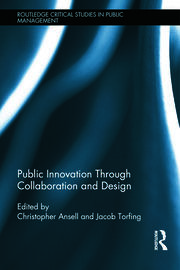
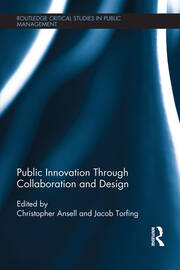
Public Innovation through Collaboration and Design
1. Collaboration and Design: New Tools for Public Innovation (Christopher Ansell and Jacob Torfing) 2. Necessity as the Mother of Reinvention: Discourses of Innovation in Local Government (Steven Griggs and Helen Sullivan) 3. Reconstructing Bureaucracy for Service Innovation in the Governance Era (Robert Agranoff) 4. The Complexity of Governance: Challenges for Public Sector Innovation (Susanne Boch Waldorff, Lone Søderkvist Kristensen, and Betina Vind Ebbesen) 5. The Impact of Collaboration on Innovative Projects: A Study of Dutch Water Management (Nanny Bressers) 6. Understanding Innovative Regional Collaboration: Metagovernance and Boundary Objects as Mechanisms (Stig Montin, Magnus Johansson Joakim Forsemalm) 7. The Importance of Joint Schemas and Brokers in Promoting Collaboration for Innovation (Barbara Gray and Hong Ren) 8. Collaborative Networks and Innovation: The Negotiation-Management Nexus (Robyn Keast and Jennifer Waterhouse) 9. Innovative Leadership Through Networks (Katrien Termeer and Sibout Nooteboom) 10. Designing Collaborative Policy Innovation: Lessons from a Danish Municipality (Annika Agger and Eva Sørensen) 11. Design Attitude as an Innovation Catalyst (Christian Bason) 12. Collaborating on Design – Designing Collaboration (Christopher Ansell and Jacob Torfing)
Biography
Christopher Ansell is a Professor in the Department of Political Science at the University of California, Berkeley, USA. He is also the US Editor of Public Administration: An International Quarterly.
Jacob Torfing is a Professor in Politics and Institutions at Roskilde University, Denmark. He is also the Director of the Centre for Democratic Network Governance and Vice-Director of a large-scale research project on Collaborative Innovation in the Public Sector.
'This brings together the key debates about design and innovation and provides a welcome comparative perspective. The contributors highlight the tension between service improvement and cost reduction in times of fiscal crisis. They also make clear that collaborative design is both high risk and high reward and give us a wealth of material on actual practices to guide us.'
Mark Considine, Professor, The University of Melbourne, Australia
'This book offers well selected and interesting examples of different possibilities in different places. It also clearly articulates the complexity of the collaborative process, and the difficulties encountered with conflicts and contestations in collaborative policy arenas.'
Michele Ferguson, The Institute for Social Science Research, University of Queensland
