





1st Edition
Purity and Contamination in Late Victorian Detective Fiction
By Christopher Pittard
Copyright 2011
272 Pages
by
Routledge
272 Pages
by
Routledge
272 Pages
by
Routledge
Also available as eBook on:
Concentrating on works by authors such as Fergus Hume, Arthur Conan Doyle, Grant Allen, L.T. Meade, and Marie Belloc Lowndes, Christopher Pittard explores the complex relation between the emergence of detective fictions in the 1880s and 1890s and the concept of purity. The centrality of material and moral purity as a theme of the genre, Pittard argues, both reflected and satirised a contemporary... Read more
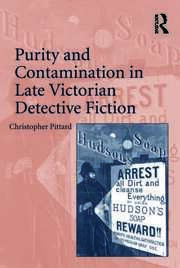
(Mrs.) Hudson’s Soap: Reading Purity in Detective Fiction; Chapter 1 ‘A strange, inverted world’: Sensation and Social Purity in The Mystery of a Hansom Cab; Chapter 2 ‘Cheap, Healthful Literature’: The Strand Magazine, Fictions of Crime, and Purified Reading Communities; Chapter 3 A Criminal Man of Many Faces: Grant Allen and the Delinquent Body; Chapter 4 Studies in Scarlet: Detection, Medicine, Vivisection; Chapter 5 Tales of the Unintended: Reinventing Victorian Criminality; Chapter 101 The Eugenics of Genre;
Biography
Christopher Pittard is Senior Lecturer in English Literature at the University of Portsmouth, UK.
'... much to relish in a work that is both theoretically informed and rigorously grounded in primary research.' Times Literary Supplement '[This] extremely readable, wide-ranging text explores late-Victorian detective fiction’s engagement with nineteenth-century issues such as poverty, prostitution, vivisection, criminal anthropology, eugenics, medicine, and with criminality as moral pollution, atavism and disease... Pittard concludes that although the late-Victorian detectives are now largely forgotten, their influence remains; his masterly revisioning of their narratives, though, recognises the importance of these agents of purity and restores them to their proper place.' Review of English Studies '... this book is both a valuable account of its own period and a strong basis for further studies of the processes of detection, whether factual or fictional.' Literature and History
