




1st Edition
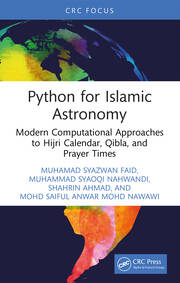
Python for Islamic Astronomy Modern Computational Approaches to Hijri Calendar, Qibla, and Prayer Times
CHAPTER 1 APPLICATION OF ISLAMIC ASTRONOMY FOR MUSLIM
CHAPTER 2 WHY PYTHON MATTERS IN ISLAMIC ASTRONOMY
CHAPTER 3 IMPORTANCE OF ACCURACY OF CALCULATION
CHAPTER 4 SETTING UP PYTHON FOR ASTRONOMICAL CALCULATIONS
CHAPTER 5 QIBLAH CALCULATION USING PYTHON
CHAPTER 6 ISTIWA’ A’ZAM AND RASHDUL QIBLA
CHAPTER 7 PRAYER TIMES CALCULATION
CHAPTER 8 MOONSIGHTING OBSERVATION DATA COMPUTATION
CHAPTER 9 QIBLAH COMPASS VISUALIZATION
CHAPTER 10 SUN POSITION DURING PRAYER TIMES VISUALIZATION
CHAPTER 11 LUNAR CRESCENT OBSERVATION DATA VISUALISATION
CHAPTER 12 CONCLUSION
Biography
Muhamad Syazwan Faid is a senior lecturer at the Department of Islamic Studies, Centre for General Studies and Co-Curricular, Universiti Tun Hussein Onn Malaysia (UTHM). His expertise lies at the intersection of Islamic Astronomy and computational sciences, where he integrates traditional Islamic astronomical practices with modern technological advancements.
Muhammad Syaoqi Nahwandi is a lecturer at UIN Syekh Nurjati Cirebon, where he specializes in Islamic Astronomy and its integration with modern scientific techniques. His academic focus includes lunar crescent visibility, prayer time calculations, and Hijri calendar determination.
Shahrin Ahmad is a renowned Malaysian astronomer and the founder of Falak Online, a platform dedicated to promoting Islamic Astronomy and public astronomy education. With extensive experience in observational astronomy, Shahrin is widely regarded as a leading figure in advancing understanding and application of Islamic astronomical practices.
Mohd Saiful Anwar Mohd Nawawi is an associate professor at the Department of Fiqh-Usul and Applied Sciences, Academy of Islamic Studies, University of Malaya (UM). A renowned scholar in Islamic Astronomy, he specializes in the development of methodologies for Hijri calendar determination, Qibla direction, and prayer time calculations.
