




1st Edition
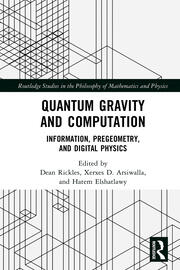
Quantum Gravity and Computation Information, Pregeometry, and Digital Physics
Part 1: Scene Setting
1. Open Questions at the Quantum Frontier Paul Davies
Part 2: Locality, Non-locality, Observers, and Agents
2. Spacetime Events from the Inside Out Gerard Milburn
3. On the Role of Locality in the Bose-Marletto-Vedral Effect Giuseppe Di Pietra, Vlatko Vedral and Chiara Marletto
4. Towards a Generalized Theory of Observers Hatem Elshatlawy, Dean Rickles, and Xerxes D. Arsiwalla
Part 3: Computational Languages for Physics
5. Topological QBits in Flux-Quantized Super-Gravity Hisham Sati and Urs Schreiber
6. Linear Homotopy Type Theory: A Computational Language for Quantum Physics David Corfield
7. Pregeometry, Formal Language and Constructivist Foundations of Physics Xerxes D. Arsiwalla, Hatem Elshatlawy and Dean Rickles
8. Quantum Information Elements in Quantum Gravity States and Processes Daniele Oriti
Part 4: Conceptual Issues for Computational Foundations
9. Do Simples Exist? The Light Shed by Computation on an Ancient Question Gemma De les Coves
10. On the Nature of Time Stephen Wolfram
11. The Prototime Interpretation of Quantum Mechanics Susan Schneider and Mark Bailey
12. Ruliology: Linking Computation, Observers and Physical Law Dean Rickles, Hatem Elshatlawy and Xerxes D. Arsiwalla
Part 5: Lattice and Hybrid Theories
13. Nonperturbative Quantum Gravity, Unlocked Through Computation Renate Loll
14. Structure and Statistical Properties of the Semiclassical Einstein Equations Daniel Terno
Biography
Dean Rickles is Professor of History and Philosophy of Modern Physics at the University of Sydney, where he is also Co-Director of the University’s interdisciplinary Centre of Time. Recent books include Dual-Aspect Monism and the Deep Structure of Meaning (co-authored with Harald Atmanspacher; Routledge 2022); and Life is Short (2022).
Xerxes D. Arsiwalla is a Mathematical Physics Fellow at the Wolfram Institute for Computational Foundations of Science, working on quantum foundations, pregeometry, higher category theory, formal language, and consciousness. He is an Academic Director of Physics Programs at Wolfram Research USA and a Co-Founder of the Association for Mathematical Consciousness Science (AMCS).
Hatem Elshatlawy is an interdisciplinary researcher working at the intersection of theoretical physics, computation, and philosophy. Formerly a Research Consultant at Wolfram Research, he has contributed to developments in observer theory, multi-computation, and metamathematics. His interests include constructivist foundations of physics, physics of computation, and the computation of physics.
