



1st Edition
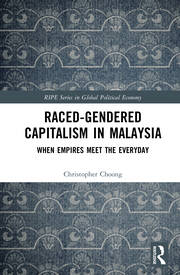
Raced-Gendered Capitalism in Malaysia When Empires Meet the Everyday
Introduction: When Empires Meet the Everyday
A personal-political journey
Where are the women?
Feminist methodology: Expanding the Bumiputera archives
Memory as a method
Reflexivity of discomfort
Navigating the book
Part I: Reconstructed accounts
Part II: Expanded archives
References
Chapter 1: Anti-colonial Raced-Gendered Capitalism in Malaysia
The developmental state as raced-gendered capitalism
Situating raced capitalism in Malaysia: colonial or anti-colonial?
Gendering the British colonial suppression of Malay capitalism
Capital as relations versus capital as things
Gendering colonial capitalist relations
Reclaiming the Japanese imperial origins of Bumiputera capitalism
Japanese racial logic and Malay nationalism
Japanese imperialist state and Bumiputera development
Registering contradictions under anti-colonial raced-gendered capitalism
Capitalist seduction and tensions
Gender and racial-religious strategies
Anti-colonial capitalism: race-gender redux
References
Chapter 2: Postcolonial Development of Bumiputera Capitalism
State ideologies under uneven and combined development
Development plans, developmental state, and Bumiputera capitalism
1MP-4MP (1965-1985): Racial restructuring
Security-development entanglements
Postcolonial eugenics
5MP-8MP (1965-2005): Creation of BCIC
Capitalist culture
Racial composition
9MP-12MP (2006-2020): Inclusive development
Post-racial rhetoric
Gendered extension
Shifting statecraft in capitalist reproduction
References
Chapter 3: Everyday Life on the Periphery
The “unworthy” everyday life
Everyday life as householding
Householding as family-making
Life-cycle trajectories
Racial boundary-making
Householding as meaning-making
Culture as systemic production
Culture as everyday realisation
Householding as home-making
Entrepreneurial housewife
State-capital hybrids
Everyday life as storytelling
References
Chapter 4: Keluarga in the Making
Trajectories of the Malay-Muslim household
Householding in Kelantan
Kelantan’s exceptionalism
Household-family-kinship under Bumiputera capitalism
Kinship as a site where productive-social reproductive activities are organised
Kinship as a network that governs the circulation of family capital
Kinship as an imaginary sphere for (racial-gender) boundary constructions
Householding as keluarga in the making
References
Chapter 5: Politics of Purifying Capital
Prologue: Story of an alternative Islamic community
Sketches of Kedah, the rice bowl of Malaysia
The life stories of Malay women in Kedah
Saleha
Puteh
Aisyah
Zurinah
Interpretive story of everyday cultural reproduction
Epilogue of an unfinished story
References
Chapter 6: Milking the Labour of Suri Rumah
Situating Farm Fresh
The coloniality of milk in Malaya/Malaysia
Completing the milk commodity circuit
Suri rumah in motion
Caring-on-the-move as value creation
Suri rumah-fication as a spectrum of violence
Agency within cosmological frames
Notes of hope and resilience
References
Conclusion: Resisting Empires in the Everyday
Transformative politics in knowledge production
The everyday as a site of resistance
Continuing the unfinished story
References
Appendix I: Timeline of Key Events
Biography
Christopher Choong completed his PhD at the University of Warwick, where he was a recipient of the Chancellor’s International Scholarship. In 2023, he was selected as the winner of the Colonial, Postcolonial, and Decolonial (CPD) Early Career Researcher Paper Prize organised by the CPD British International Studies Association Working Group. His thesis received an honourable mention for the Michael Nicholson Thesis Prize in 2026. Christopher holds an MSc in Inequalities and Social Science from the London School of Economics and Political Science (LSE), University of London, where he was awarded the Atkinson Prize; an MSc in Development Economics from the School of Oriental and African Studies, University of London; and a BSc in Economics from the University of Malaya. Christopher is currently Deputy Director of Research at the Khazanah Research Institute, and a Senior Fellow at the Atlantic Fellows for Social and Economic Equity at the International Inequalities Institute, LSE. In recognition of his academic and professional achievements, he is appointed as Adjunct Associate Professor with the Jeffrey Sachs Center on Sustainable Development, Sunway University.
