




1st Edition
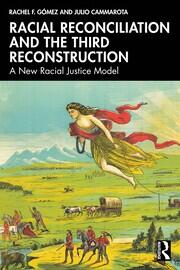
Racial Reconciliation and the Third Reconstruction A New Racial Justice Model
Lists of figures
List of tables
List of boxes
List of contributors
Preface
Acknowledgements
Introduction: Challenges in Education: The Need for Racial Justice in the Third Reconstruction Era
Rachel F. Gómez and Julio Cammarota
Chapter 1: Understanding the Three Reconstruction Eras
Rachel F. Gómez, Julio Cammarota and Greg Wickenkamp
Chapter 2: Uncovering White Supremacy in and Beyond Education
Rachel F. Gómez and Julio Cammarota
Chapter 3: The Rise and Demise of DEI: Representation and Power in the Third Reconstruction
Rachel F. Gómez and Julio Cammarota
Chapter 4: Power, White Supremacy, and the Perpetuation of Harm
Rachel F. Gómez and Julio Cammarota
Chapter 5: Healing and the Racial Justice Model: Participatory Accountability and Collective Dialogue
Julio Cammarota and Rachel F. Gómez
Chapter 6: Conclusion: The Path Forward: Avoiding Apartheid with Truth and Reconciliation
Julio Cammarota, Rachel F. Gómez, Ricardo Martinez and Maure Aguirre‑Ortega
Glossary of Key Terms
Index
Biography
Rachel F. Gómez is Assistant Professor of Foundations of Education at Virginia Commonwealth University and a scholar of Ethnic Studies. Her research examines race, power, and epistemic justice in U.S. education. Grounded in critical race theory and decolonial thought, her work interrogates how curriculum, policy, and historical narratives reproduce or challenge white supremacy. She publishes on sociopolitical development, racial ideology, and justice‑oriented pedagogy, focusing on the experiences and liberatory practices of Black and Latina/o/e communities.
Julio Cammarota is a Professor of Education at the University of Arizona. His research focuses on participatory action research with Latinx youth, institutional factors in academic achievement, critical race theory, and liberatory pedagogy. He is the co‑editor of two volumes in the Routledge Critical Youth Studies series, has published an ethnography of Latinx youth, and has recently edited a volume on liberatory pedagogy.
“This book makes a salient case for the possibility and urgency of a Third Reconstruction era. It builds on existing foundational research and addresses an issue that many have grappled with but have yet to address directly. Bringing greater attention to the concepts of white supremacy and power while building a model to promote health/racial justice, this will be a key resource for constructive understanding, organizing, and action.”
Heather O'Connell, Associate Professor of Sociology, Louisiana State University
“This volume offers an important contribution to the notion of racial justice and a Third Reconstruction in the United States. Focusing on (and advocating for) the Third Reconstruction, which is underway in the U.S. but only just beginning, offers more concrete possibilities for understanding the pathways to racial justice in the US. Yes, racial reconciliation is critical to the struggle for racial justice, but racial reconciliation is only possible AFTER a Third Reconstruction. With this framework, this book will be an important resource on the pathway toward that racial reconciliation.”
Cynthia Pelak, Associate Professor of Sociology, New Mexico State University
