



1st Edition
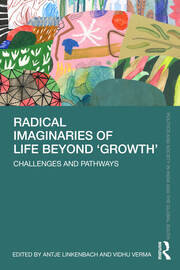
Radical Imaginaries of Life Beyond 'Growth' Challenges and Pathways
Antje Linkenbach and Vidhu Verma Thinking and Acting Beyond Growth - A Kaleidoscope of Trajectories: Introduction
Section A Growth and its Critique
Section Introduction
1. Sukumar Muralidharan The Growth Mystique, and the Convenient Silences of Theory
2. Christoph Henning Better Living without Growth: Assessing the Degrowth Criticism of the Sustainable Development Goals and the Green New Deal
Section B (De-)Growth from a Decolonial Perspective
Section Introduction
3. Roland Nkwain NgamDegrowth in an African Periphery: Centring the Victims of Capitalocene and the Pluriversal Pathway Forward
4. Aditya Nigam Degrowth, Capital and the Global South
Section C Life beyond Growth: A Radical Holistic Imaginary
Subsection C.1: Substantive Economics or Economics of Permanence
Subsection Introduction
5. Julien-François Gerber Elements of an Indian Theory of ‘Degrowth’: Revisiting South Asian Roots of Substantive Economics
6. Rajeswari S. Raina Towards a Village-centered Post-growth Economy in India: Institutional Changes for Sustainability
Subsection C.2: Agroecology. Solidarity Economy, Approaches to Food Sovereignty
Subsection Introduction
7. León Enrique Ávila Romero and Nadine Pollvogt Agroecology: Transforming Food Systems in Latin America
8. Leandro Pereira Morais and Miguel Juan Bacic Alternative Development, Social and Solidarity Economy, and Resignifications in the Post-COVID-19 World: A Reflection Based on Family-farming Cooperatives in Brazil
Subsection C.3: Appropriate Knowledges, Technologies and Education
Subsection Introduction
9. Shivani Kaul, Sonam Pelden, Yedzin Wangmo, Deki Yangzom Lenchak and the Postgrowth Possibilities of a Tendrel Logic of Intervention in Bhutan
10. Alex Jensen Appropriate Technology, Traditional Cultures and Degrowth
11. Pallavi Varma Patil and Sujit Sinha Unlearning Growth: Alternative Education for a Post-Growth World
Subsection C.4: ‘Living Well’ in a Pluriversal World
Subsection Introduction
12. Hartmut Rosa Relational Subjectivities in a Post-Growth Society: Decolonizing the Monological Self
13. Ashish Kothari In Search of Alternatives to Development: Learning from Grounded Initiatives
Biography
Antje Linkenbach, anthropologist and sociologist, is long-term Fellow at the Max Weber Centre for Advanced Cultural and Social Studies, University of Erfurt, Germany.
Vidhu Verma, political scientist, is currently Professor, Centre for Political Studies, School of Social Sciences, Jawaharlal Nehru University, New Delhi, India.
“With her characteristic brilliance and perspicacity, Mary E. John makes a signal contribution to feminist scholarship in this book. Her genealogy of child marriage draws upon historical, comparative, and intersecting analytical frameworks. This deep and nuanced contextualization compels us to consider afresh what we had long assumed we knew about a familiar subject. Her argument about "compulsory marriage," which she introduces to reframe the discussion of child marriage, offers an important conceptual advance that will likely become a valuable new resource in the feminist toolkit. This is one of the most original and exciting feminist interventions to come along in a while.” — Mrinalini Sinha, Alice Freeman Palmer Professor of History, University of Michigan, USA
“This elegantly incisive book by Mary E. John, one of India’s leading feminist scholars, challenges us to interrogate some of the myths of reason and progress that we complacently live by. Her object of study is public discourse and social policy on the issue of child marriage, a ‘social problem’ which, for close on two centuries, has been an object of attention by Indian social reformers, women’s movement activists, and latterly, in a global context, by international development agencies. In a tour de force, John decodes the intricacies of various data sets and the assumptions that drive them, to suggest that it is not child-marriage that is the problem for Indian women, but rather the ‘compulsory’ nature of marriage itself which must be the frame of reference for genuine change.” — Patricia Uberoi, Retired Professor, Institute of Economic Growth & Chairperson, Institute of Chinese Studies, New Delhi, India
