





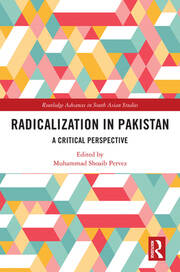
1st Edition
Radicalization in Pakistan A Critical Perspective
1. Introduction
Muhammad Shoaib Pervez
Part I Educational Aspect
2. Education and Radicalization in Pakistan: A Post-Colonial Perspective
Fatima Waqi Sajjad
3. Teaching Toward a Culture of Peace: Analysis of Islamiyat and Ethics Textbooks
Ashar Johnson Khokhar
4. Infusing Cultural Diversity into Pakistan Studies Textbooks: An Analysis of Textbooks and Teachers’ Perspectives
Yaar Muhammad and Peter Brett
Part II Religious Aspect
5. Pacifying Sunni-Shī’ite Relations in Pakistan: Patterns of (De)Humanization and Prospects of Trust-Building
Sohaib Ali and Fatima Waqi Sajjad
Part III Geopolitical Aspect
6. The radicalized regional order of India-Pakistan and prospects of a Security Community
Muhammad Shoaib Pervez
7. Deconstructing the Myth of Pashtuns being Extremist and Warrior Nation: Causes of radicalization in Khyber Pakhtunkhwa
Arshad Ali and Fazal Subhan
8. Conclusion
Muhammad Shoaib Pervez
Biography
Muhammad Shoaib Pervez is an Associate Professor and Chair of the Department of Political Science and International Relations at the University of Management and Technology, Pakistan. His book Security Community in South Asia, also published by Routledge (2012), was awarded the National Outstanding Research Award for the best book in Social Science 2012 by the Higher Education Commission, Government of Pakistan. He was also the Fulbright Post-Doctoral Fellow at the Saltzman Institute of War and Peace Studies at SIPA, Columbia University, USA from 2014 to 2015.
"In a nutshell, this book forms a great read for anyone interested in the place of knowledge production systems in radicalisation, extremism, and counterterrorism studies. […] it clarifies how the nuances in the education curriculum exacerbate the problem of systemic radicalisation in society." Critical Studies on Terrorism. April 2021.
"Dr. Pervez’s book is an intriguing and challenging read for any Pakistani or a student of Pakistan politics who has a desire to academically approach the question of radicalization. Structurally, the book has been divided into three broad categories: educational norms, religious practices, and geopolitical aspects of radicalization. The underlying idea is to explore different dimensions of radicalization and dissect the existing policy discourse with an aim to offer an alternative perspective. […] Overall, this book is an interesting read for anybody interested to understand radicalization, its various dimensions and alternative policy measures to counter it." Farah Adeed, University of Management & Technology, Pakistan, Global Village Space, May 2021
