




1st Edition
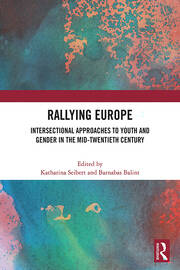
Rallying Europe Intersectional Approaches to Youth and Gender in the Mid-Twentieth Century
Introduction - Rallying Europe: Young women and men searching for a life and a future
Katharina Seibert and Barnabas Balint
1. Traces of youth: Reconstructing Hungarian women’s lives during the Holocaust
Barnabas Balint
2. Unreachable youth: Physical education, national mobilization and intergenerational conflict in interwar Yugoslavia. The case of the Yugoslav Sokol
Jovana Papovic
3. ‘Fragt denn da ein junger Mensch nach?’: Would a young person ask that? Growing up in the Reichsarbeitsdienst in 1942
Gero von Roedern
4. Una Coscienza Coloniale: forging imperial women in the Fascist Colonial Institute of Bologna
Lewis Ewan Driver
5. The ‘New Woman’ of Weimar Germany in the imaginations of young Iranian intellectuals
Sheragim Jenabzadeh
6. ‘In this country, women are also soldiers’: Interrelations between age and gender in the women’s section of the Romanian Legionary Movement
Anca Diana Axinia
7. Health, home and hearth: How war nurses negotiated their place at the table during the dawn of Francoist Spain
Katharina Seibert
Biography
Katharina Seibert is PostDoc Researcher at the Department for Contemporary History at the University of Tübingen, Germany. She earned her PhD from the University of Vienna with her thesis “Who Cares? Negotiating Gender and Society at Spain’s Sickbeds during the 1930s and 1940s”. She specializes in the European and Spanish history of the twentieth century, gender and queer history, and the history of medicine.
Barnabas Balint completed his doctorate in history at Magdalen College, University of Oxford, United Kingdom, where his research explored Jewish life during the Holocaust in Hungary. He is the 2024/ 5 Miles Lerman Center for the Study of Jewish Resistance Research Fellow at the Jack, Joseph and Morton Mandel Center for Advanced Holocaust Studies, United States Holocaust Memorial Museum.
