




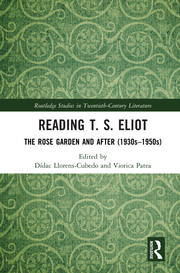
1st Edition
Reading T. S. Eliot The Rose Garden and After (1930s–1950s)
Introduction: "Through the First Gate," into the Rose Garden and Beyond
Dídac Llorens-Cubedo and Viorica Patea,
Part I The Poet, the Rose Garden, and the Playhouse (1930s)
Poetics of the Incarnation: T. S. Eliot’s Four Quartets
Barry Spurr
Experiencing Murder in the Cathedral: How "Indicative Criticism" Can Position Audiences to Appreciate the Play
Charles Altieri
"That moment of mystery": T. S. Eliot’s Practical Cats as a Turning Point
Ester Díaz Morillo
To Speak Poetry: Eliot’s Project to Revive Verse Drama
Natalia Carbajosa Palmero
"Chiefly your doing": Emily Hale and the Making of a Playwright
Sara Fitzgerald
Part II Full-Time Dramatist with a Vision (late 1930s-late 1950s)
T. S. Eliot and Greek Drama
Peter Liebregts
Eliot, Aeschylus, and Aristotle: Theme and Plot in The Family Reunion
Jewel Spears Brooker
Protean Self and Anagnorisis through Art in T. S. Eliot’s The Confidential Clerk
Leonor María Martínez Serrano
'Proper Sowing' and 'right action' in Eliot’s Plays and Four Quartets
Viorica Patea
After Four Quartets: T. S. Eliot’s Comedies as Footnotes or Exempla
Dídac Llorens-Cubedo
Part III Critic with a Wider Scope (1940s-1960s)
To Criticize the Dramatist: Eliot on His Plays
Teresa Gibert
The Responsibility of a Christian Thinker: T. S. Eliot, World War 2, and Post War Reconstruction
Joana Rzepa
Patristic Christianity in T. S. Eliot’s Philosophy of Education
John Rhett Forman
Christopher Dawson and Eliot on Culture and Politics
Benjamin G. Lockerd
Biography
Dídac Llorens-Cubedo is Associate Professor of English at the Universidad Nacional de Educación a Distancia (UNED, Spain). He has published T. S. Eliot and Salvador Espriu: Converging Poetic Imaginations (2013) and co-edited New Literatures of Old: Dialogues of Tradition and Innovation in Anglophone Literatures (2008) and T. S. Eliot. Teatro Completo (2022).
Viorica Patea is Professor of English Literature at the University of Salamanca. She has published books on Sylvia Plath, Ezra Pound, and T.S. Eliot. Her edited books include Short Story Theories (2012), Modernism Revisited (2007) with Paul Scott Derrick, and Ezra Pound & the Spanish World (2024) with John Gery.
