
1st Edition

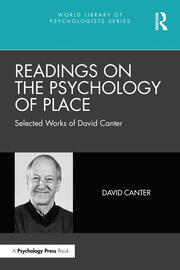
Readings on the Psychology of Place Selected Works of David Canter

By David Canter Copyright 2024
298 Pages 60 B/W Illustrations
by Routledge

298 Pages 60 B/W Illustrations
by Routledge

298 Pages 60 B/W Illustrations
by Routledge

In the World Library of Psychologists series, international experts present career-long collections of what they judge to be their most interesting publications – extracts from books, key articles, research findings and practical and theoretical contributions. In this fascinating volume, Professor David Canter refl ects on a career that has earned him an international reputation as one of the... Read more
Foreword  1. Architectural Psychology  Part 1: Origins of The Psychology of Place  2. Office Size: An example of psychological research in Architecture  3. The Need for a Theory of Function in Architecture  4. Should we treat building users as subjects or objects?  5. Judgements of People and Their Rooms  6. Distance Estimation in Cities  7. The Psychology of Place  Part 2: Elaborating the Theory of Place  8. The Purposive Evaluation of Places  9. Putting situations in their place: Bridging social and environmental psychology  10. Intention, meaning and structure: Social action in its physical context  11. Action and Place: an existential dialectic  Part 3: Methodology - Studying Place Experience  12. A Non-Reactive Study of Room Use in Modern Japanese Apartments  13. Picture Or Place? A Multiple Sorting Study of Landscape  14. Revealing the Conceptual Systems of Places  Part 4: Applications - The Theory of Place in Action  15. Intentionality and Fatality during the Kings Cross Underground Fire  16. The Environmental Range of Serial Rapists  17. Why do we Leave it so Late? Response to Environmental Threat and the Rules of Place  18. Creating Places without Designers  Bibliography

Biography

David Canter is one of the U.K.’s most eminent applied social psychologists, being one of the few to be appointed as Honorary Fellow of the British Psychological Society and having been elected as a Fellow of the Academy of Social Sciences, the American Psychological Association and the Royal Society of Medicine. Although he is internationally known for his development of the discipline of Investigative Psychology, bringing scientific precision to ‘offender profiling’, his earlier and continuing work centres on the development of Architectural/environmental psychology, establishing the well-respected Journal of Environmental Psychology in 1980 and the International Association for People-Environment Studies (IAPS). He has worked as a management consultant to major U.K. companies on risk reduction, amalgamations and briefing for new building complexes and has given advice to government inquiries into disasters. He wrote and presented a six-part documentary series, Mapping Murder, which is also published as a widely read book. He is Emeritus Professor at the University of Liverpool, U.K.
