




1st Edition
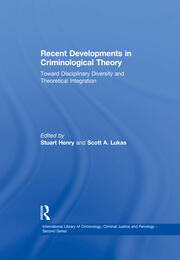
Recent Developments in Criminological Theory Toward Disciplinary Diversity and Theoretical Integration
560 Pages
by
Routledge
560 Pages
by
Routledge
Also available as eBook on:
This volume contains recent and cutting-edge articles from leading criminological theorists. The book is organized into ten sections, each representing the latest in the multi-disciplinary orientations representing a cross-section of contemporary criminological theory. These sections include: 1: Classical and Rational Choice; 2: Biological and Biosocial; 3: Psychological; 4: Social Learning and... Read more
Contents: Introduction; Part I Classical and Rational Choice Theories: Rational choice, deterrence, and theoretical integration, David A. Ward, Mark C. Stafford and Louis N. Gray; A crying shame: the over-rationalized conception of man in the rational choice perspective, Willem de Haan and Jaco Vos. Part II Biological and Biosocial Theories: A theory explaining biological correlates of criminality, Lee Ellis; Behavior genetics and anomie/strain theory, Anthony Walsh. Part III Psychological Theories: An alternative psychology of criminal behavior, Julie Horney; A sociocognitive analysis of substance abuse: an agentic perspective, Albert Bandura. Part IV Social Learning and Neutralization Theories: Moral disengagement in the perpetration of inhumanities, Albert Bandura; When being good is bad: an expansion of neutralization theory, Volkan Topalli. Part V Social Control Theories: In defense of self-control, Travis Hirschi and Michael R. Gottfredson; Refining control balance theory, Charles R. Tittle. Part VI Social Ecology, Subcultural and Cultural Theories: Transcending tradition: new directions in community research, Chicago style, Robert J. Sampson; New directions in social disorganization theory, Charis E. Kubrin and Ronald Weitzer. Part VII Anomie and Strain Theories: Anomie, social change and crime, Jon Gunnar Bernburg; Building on the foundation of general strain theory: specifying the types of strain most likely to lead to crime and delinquency, Robert Agnew. Part VIII Conflict and Radical Theories: Revisionist history, visionary criminology, and needs-based justice, Gregg Barak; The state of the criminology of crimes of the state, Dawn L. Rothe and David O. Friedrichs. Part IX Feminist and Gender Theories: Patriarchy, crime, and justice: feminist criminology in an era of backlash, Meda Chesney-Lind; Feminist state theory: applications to jurisprudence, criminology, and the welfare state, Lynne A Haney. Part X Critical Criminologies: Anarchist, Postmodernist, Peacemaking: Constitutive criminology: origins, core concepts, and evaluation, Stuart Henry and Dragan Milovanovic; Against the law: anarchist criminology, Jeff Ferrell; Restorative justice: what is it and does it work?, Carrie Menkel-Meadow. Part XI Conclusion: Interdisciplinary integration: building criminology by stealing from our friends, D. Wayne Osgood; Name Index.
Biography
Stuart Henry, Professor, Director of the School of Public Administration & Urban Studies, San Diego State University, USA and Scott A. Lukas, Professor of Anthropology & Sociology, Lake Tahoe Community College, USA.
