




1st Edition
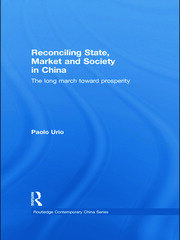
Reconciling State, Market and Society in China The Long March Toward Prosperity
By Paolo Urio
Copyright 2010
304 Pages
19 B/W Illustrations
by
Routledge
304 Pages
19 B/W Illustrations
by
Routledge
304 Pages
19 B/W Illustrations
by
Routledge
Also available as eBook on:
Analysing post-Mao China is not an easy task, but it is essential in order to understand the rationale and scope of the reform process started by the Chinese leadership under the guidance of Deng Xiaoping at the end of the 1970s. Thirty years after the beginning of the reform process China has become a major actor in the global economic and political system and the 21st century is generally held... Read more
1. Chinese political culture and why it does matter 2. Deng’s strategy of economic development 3. Correcting the negative consequences of economic development 4. Understanding China after Mao 5. Conclusion
Biography
Paolo Urio is Professor Emeritus of Public Administration and Management at the University of Geneva, Switzerland.
'The research question this book raises is highly relevant in today’s context, at a time when the Hu-Wen era has ended and the task of achieving a harmonious society seems to be getting more and more challenging for the Chinese leadership. In particular, the author highlights the issues of rising social inequalities and the legal aspects of reform in post-Mao China. These issues hold immense significance in today’s China, where questions related to governance and social management have become the most important challenge facing the Chinese leadership.' - G. Venkat Raman; JOURNAL OF CHINESE POLITICAL SCIENCE (2013)
