





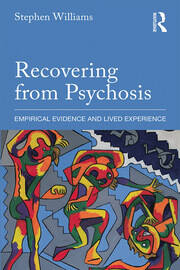
1st Edition
Recovering from Psychosis Empirical Evidence and Lived Experience
The Aims and Intentions of Recovering From Psychosis: Empirical Evidence and Lived Experience. Introduction to Psychosis, Recovery, Post-Modernity and Trans-Modernity. An Autoethnographic Account of Psychosis In the Context of Neurobiological, Cognitive Psychological and Meta-Synthetic Analysis. A Review of Current UK Treatment Approaches to Psychosis: Surveying Contemporary Interventions and Their Empirical Status. Research into Recovery From Psychosis: An Empirical Review and Critical Reflection. Recovery, Psychosis and Identity. Political Dimensions of Recovery. Measuring Recovery: The Tyranny of Psychometry? Beyond Recovery: Promoting Well Being. Reflections Upon Recovery: The Person is Political.
Biography
Stephen Williams is a lecturer-practitioner in Mental Health Nursing at the University of Bradford.
"This courageous and novel text will, I predict, prove to be of enduring and vital importance for mental health nurses and other mental health professionals and recovery researchers, and for survivor, user and carer groups across many countries." - Alec Grant, PhD, Reader in Narrative Mental Health, School of Health Sciences, University of Brighton, UK (From the Foreword)
"A very powerful tome. Much of the literature is familiar and his analysis of the current ideas are comprehensive and thought provoking. I found it a relaxed and easy read, despite its topic. By that I didn't have to work too hard to understand what was being said. It was coherent and followed a helpful trajectory. I was engrossed in chapter three and it was helpful how his narrative was punctuated with academic analysis. What a sad, yet powerful transformative story." - Nigel Short, Informal Associate, School of Psychology, University of Sussex, UK and co-editor of Contemporary British Autoethnography, Short, N.P., turner, L. and Grant, A. (Sense-Publishers, 2013)
