





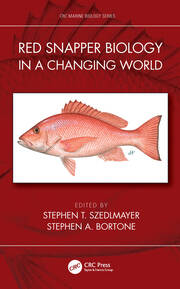
1st Edition
Red Snapper Biology in a Changing World
Preface
Acknowledgments
Editors
Contributors
Chapter 1
Introduction
Stephen A. Bortone and Stephen T. Szedlmayer
Early Life History
Chapter 2
Red Snapper, Lutjanus campechanus, Larval Dispersal in the Gulf of Mexico
Donald R. Johnson and Harriet M. Perry
Chapter 3
Juvenile Red Snapper, Lutjanus campechanus, Densities on Small Artificial
Reefs to Estimate Year-Class Strength
Peter A. Mudrak and Stephen T. Szedlmayer
Site Fidelity, Movements, and Mortality
Chapter 4
A Review of Red Snapper, Lutjanus campechanus, Acoustic Telemetry Studies
Laura Jay Williams-Grove and Stephen T. Szedlmayer
Chapter 5
Fishing Mortality Estimates for Red Snapper, Lutjanus campechanus, Based
on Acoustic Telemetry and Conventional Mark-Recapture
Peter A. Mudrak and Stephen T. Szedlmayer
Environmental Effects
Chapter 6
Polycyclic Aromatic Hydrocarbons in Red Snapper, Lutjanus campechanus,
and Sediment Samples after the Deepwater Horizon Oil Spill
Claire E. Roberts and Stephen T. Szedlmayer
Chapter 7
The Effects of Modeled Dispersed and Undispersed Hypothetical Oil Spills
on Red Snapper, Lutjanus campechanus, Stocks in the Gulf of Mexico
Benny J. Gallaway, Wolfgang J. Konkel, and John G. Cole
Diets and Age Determination
Chapter 8
Diet Analyses of Red Snapper, Lutjanus campechanus, Based on DNA
Barcoding from Artificial Reefs in the Northern Gulf of Mexico
Stephen T. Szedlmayer and Rachel A. Brewton
Chapter 9
Timing of Opaque Band Formation and Validation of Annular Increments in
Otoliths of Red Snapper, Lutjanus campechanus
Stephen T. Szedlmayer, Erin J. Fedewa, and Morgan L. Paris
Chapter 10
A Comparison of Age Determination between Whole and Sectioned Otoliths
in Red Snapper, Lutjanus campechanus
Stephen T. Szedlmayer and Danielle J. Grundy
Management
Chapter 11
Improving the Historical Baseline of the Gulf of Mexico Red Snapper,
Lutjanus campechanus, Fishery
G.R. Fitzhugh, W.C. Kline, C.E. Porch, and C.L. Gardner
Chapter 12
Management Strategies Influencing Recreational Red Snapper, Lutjanus
campechanus, Effort in the Gulf of Mexico: Why Can’t We Agree?
Carrie M. Simmons, R. Ryan Rindone, and Michael F. Larkin
Chapter 13
A Comparison of Two Fishery-Independent Surveys of Red Snapper,
Lutjanus campechanus, from 1999–2004 and 2011–20154
Stephen T. Szedlmayer, Peter A. Mudrak, and Jessica Jaxion-Harm
Chapter 14
Artificial Reefs in the Future Management of Red Snapper, Lutjanus
campechanus
Stephen A. Bortone
Biography
Stephen T Szedlmayer, Ph.D., attended Millersville University, Lancaster, PA, for undergraduate studies. He then entered the University of South Florida and earned a Master’s degree in the Marine Science program under the supervision of Professor John C. Briggs. After graduating from USF he worked for a short period at Mote Marine Laboratory, Sarasota FL, before entering the graduate program at the Virginia Institute of Marine Science, College of William and Mary, Gloucester Point, VA. After completing his Ph.D., he accepted a post-doctoral position at the Rutgers University Marine Field Station, Tuckerton NJ, and collaborated with Professor Kenneth W. Able. He was then hired the School of Fisheries, Aquaculture and Aquatic Sciences, Auburn University, AL. While at Auburn he rose through the ranks to Professor, and mentored numerous graduate students on studies of various aspects of marine fish ecology.
Recently retired as Executive Director of the Gulf of Mexico Fishery Management Council, Stephen A. Bortone now is an Environmental Consultant with Osprey Aquatic Sciences, LLC based in Windham, New Hampshire (USA). As a consultant, he specializes in fisheries and is noted especially as an authority on artificial reefs. Currently, he is also Marine Biology Series Editor with CRC Press. Previously, Dr. Bortone served as Director of the Minnesota Sea Grant College Program with an appointment as Professor of Biology at the University of Minnesota Duluth. Earlier in his career he was the founding Director of the Marine Laboratory at the Sanibel-Captiva Conservation Foundation in Sanibel, Florida, Director of Environmental Science at the Conservancy of Southwest Florida, and Director of the Institute for Coastal and Estuarine Research while Professor of Biology at the University of West Florida
