




1st Edition
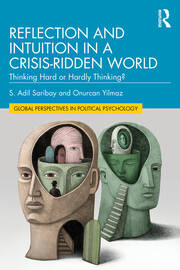
Reflection and Intuition in a Crisis-Ridden World Thinking Hard or Hardly Thinking?
Part I 1. The Intuitive Mind 2. Dual Process Models of the Mind 3. Development and Training of Reflective Thinking Part II 4. Situational Influences on Reflectiveness: Threat and Politics 5. Epistemically Suspect Beliefs 6. Ideology 7. Morality and Cooperation 8. Violent Extremism Part III 9. Revisiting Reflectionism 10. Revisiting the Dual-Process Model of the Mind Conclusion: Final Thoughts
Biography
S. Adil Saribay is a Professor of Psychology at Kadir Has University, Istanbul, Turkey. His research focuses on cognitive style and face perception.
Onurcan Yilmaz is an Associate Professor of Psychology at Kadir Has University, Istanbul, Turkey, and currently leads the Moral Intuitions Laboratory (MINT Lab). His research primarily focuses on the cognitive and contextual determinants of moral judgment and behavior.
‘An interesting and very broad survey of much current thinking about reflection and intuition and their relation to public issues. It is special in recognizing connections with social psychology, which is often neglected in the literature and often unfamiliar to me.’
Jonathan Baron, Professor Emeritus of Psychology, School of Arts and Sciences, University of Pennsylvania, USA
'The field of cognitive science is well served by this book which expands and extends the concept of cognitive reflection into broad-based areas that are politically charged and full of real-world implications. This volume takes reflection out of the laboratory and connects it to pressing cultural and political debates.'
Keith E. Stanovich, Emeritus Professor of Applied Psychology and Human Development, University of Toronto, Canada
