




1st Edition
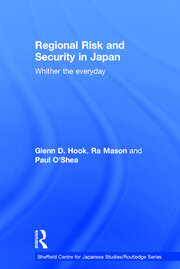
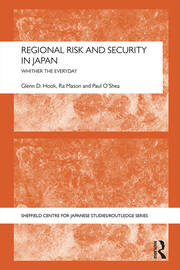
Regional Risk and Security in Japan Whither the everyday
Introduction Part I:The ‘China threat’ and Sino-Japanese relations Introduction 1. Food security, safety and bioterrorism 2. Transboundary pollution 3. East China Sea dispute 4. Immigration and the demographic crisis Part II: Deconstructing the framing of North Korea Introduction 5. Missile testing 6. North Korean abductions 7. Nuclear testing 8. Drugs and money Part III: Internalizing the US-Japan alliance in Okinawa Introduction 9. Military accidents 10. Military incidents 11. Environmental degradation 12. Noise pollution. Conclusion.
Biography
Glenn D. Hook is Toshiba International Foundation Anniversary Research Professor, School of East Asian Studies at the University of Sheffield, UK and director of the National Institute of Japanese Studies, part of the White Rose East Asia Centre, a collaboration between Sheffield and the University of Leeds, UK. His recent books include Japan’s International Relations: Politics, Economics and Security (co-author, Routledge, 2012, third edition).
Ra Mason is a lecturer in Asia-Pacific Studies at the University of Central Lancashire, UK, special research fellow with the Japan Society for the Promotion of Science at the University of the Ryukyus (2014–15), Japan, and an honorary fellow of the White Rose East Asia Centre, University of Sheffield, UK. His recent publications include Japan’s Relations with North Korea and the Recalibration of Risk (Routledge, 2014).
Paul O’Shea is an assistant professor of Asian Studies at Aarhus University, Denmark and an honorary fellow of the White Rose East Asia Centre, University of Sheffield, UK. He has recently co-edited a volume entitled Risk State: Japan’s Foreign Policy in an Era of Uncertainty (2015).
"Authored by three European scholars affiliated with the University of Sheffield’s East Asia Centre, the work explores Japanese policy related to three broad security issues: China, North Korea, and US military bases in Okinawa... Summing Up: Recommended. Graduate students." - C. W. Sherrill, Troy University, CHOICE
"(The book) provides an important linkage between the state and its people regarding security issues by utilizing the risk recalibration process. Thus, the idea of risk used in this book departs from previous studies on risk and treats it as ‘a heuristic device to illuminate how the recalibration of risk is manifested as harm to the security of the people’... this book is an important read not only for scholars but also practitioners who deal with these issues on a day-to-day basis." - Wakana Mukai, The University of Tokyo, Japan
