



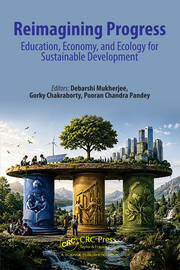
1st Edition
Reimagining Progress Education, Economy, and Ecology for Sustainable Development
Foreword
Preface
Introduction
SECTION 1: PROGRESSING SUSTAINABLY
1. A Composite Index of Stride: Measuring and Mapping India’s Educational Sustainability Landscape
Agnus Infanta B. and Jayanthi M.
2. Teaching Within the Safe and Just Space: The Doughnut Pedagogy Model for Sustainability Education
Kandarp Acharya and Mili Gondaliya
SECTION 2: EDUCATION AS A PILLAR OF SUSTAINABILITY
3. Designing E-Learning for Systems Thinking in Sustainability Education
Palak Gupta and Mini Verma
4. Legal Education 2.0: A Roadmap For Future Pedagogical Approaches
Aparajita Banerjee, Subhayan Chakraborty and Lokesh Kumar Jena
5. Role of Indian Higher Education Institutions and Green Human Resource Management as Mediators to Sustainable Development
Nirmalya Debnath, Jayanta Das and Goutam Deb
6. From Policy to Practice: A Bibliometric Study of ESD Integration in Indian Higher Education Systems
Swaricha Johri and Neha Puri
7. Blending Digital Pedagogy and Ethnomathematics for Advancing Education for Sustainable Development
Ruhit Bardhan and Utpal Debnath
SECTION 3: ECONOMY AND ECOLOGY IN PRACTICE
8. A Conceptual Framework for Adaptive AI in Agriculture: Enabling Self Learning Systems for a Sustainable and Resilient Supply Chain
Lokesh Kumar Jena, Dukhabandhu Sahoo, Subhayan Chakraborty, Pritisudha Mohanty and Manash Kumar Behera
9. Volatility Spillovers in Energy Markets: Assessing the Economic Viability of Renewable vs. Non-Renewable Energy in India
Avijit Bakshi and Sarit Maitra
10. Transformative Dynamics of Rubber Plantations in Tripura: Linking Growth, Sustainability, Social Inclusion and Future Projections
Bhaskar Datta, Rajesh Chatterjee, Debarshi Mukherjee, Abdur Rahman Choudhury and Abhranil Bhattacharjee
11. Understanding Sustainability in Impermanent Land
Hassan Momin and Gorky Chakraborty
12. Conscious Leadership and Employee Behaviour for Organizational Sustainability
Charul Sharma, Sweta Dixit and Bhupender Kumar Som
SECTION 4: PATHWAYS TO A SUSTAINABLE FUTURE
13. India’s Economic Growth and Development Trends & Issues: Past, Present and Future
Pintu Majhi and Seemarani Meher
14. Pathways to Sustainable Future in Gender, Equity and Sustainable Development
Shanmuga Shree S.P. and Mritunjay Kumar
15. The Role of Digital Public Infrastructure in Advancing Inclusive Governance and Development in India
Debarshi Mukherjee and Muhammad Faiz Qamar
16. From Skills to Sustainability: Women’s Empowerment in the Entrepreneurial Ecosystem
Pranati Dash and Kunal Gaurav
Biography
Debarshi Mukherjee: He is a professor in the Department of Commerce and Business Studies at Jamia Millia Islamia, New Delhi. His research focuses on AI literacy, social intelligence, learning continuity, marketing psychology, and the future of education. He is the originator of the Theory of Learning Continuity and holds intellectual property rights to the Learner Matrix for Learning Continuity and related learning analytics frameworks. A prolific author, mentor, and academic leader, he has made extensive contributions to research, innovation, policy, and the development of higher education.
Gorky Chakraborty: He is a faculty member at the Institute of Development Studies Kolkata (IDSK), specialising in development, citizenship, borders, and indigenous communities in Northeast India. His scholarship explores questions of identity, sustainability, land, power, and frontier transformations. He has authored and edited several influential volumes, including works published by Routledge, Springer, Orient BlackSwan, Palgrave Macmillan, and Concept. Through his research, he has made significant contributions to contemporary debates on borderlands, development, and socio-political change in Northeast India.
Pooran Chandra Pandey: He is Director of the Climate Centre at South Asian University, a Chevening Fellow at LSE and holds an MPhil from Jawaharlal Nehru University. He has held senior positions with the UN, Times of India, DOC Research Institute, and Nippon Denro Ispat. A former board member of the World Food Programme Trust and leader of the ACC social audit, he currently chairs the BIS’s ESG Committee. He advises governments on labour mobility, universal basic income, and development, and is a widely published author.
