
1st Edition

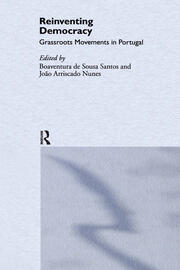
Reinventing Democracy Grassroots Movements in Portugal

302 Pages
by Routledge

302 Pages
by Routledge

302 Pages
by Routledge

The studies gathered in this volume focus on Portuguese society, from the creative social and political experimentation by citizen and popular movements during the revolution of 1974/75 to more recent episodes of alternative economic organisation, popular mobilization over the claim of local populations to self-government, local environmental conflicts, transformations in trade-unionism,... Read more
1. Introduction: Radical democracy, recognition and redistribution: reinventing democracy and social emancipation in contemporary Portugal  2. Reinventing Democracy  3. Citizen Local Action as a Way of Resistance Against the New Wave of Worldwide Colonisation: The case of the 'In Loco Association' in Southern Portugal  4. "Decent Housing for the People": Urban movements and emancipation in Portugal  5. The Territory as Space for Collective Action: Paradoxes and possibilities of the "strategic game of actors" in territorial planning in Portugal  6. A Town in Protest: Memory, populism and democracy  7. "Don't Treat Us Like Dirt!": The fight against the co-incineration of hazardous industrial waste in the outskirts of Coimbra  8. Sexual Orientation in Portugal: Towards emancipation  9. Who Saved East Timor?: New references for international solidarity  10. Portuguese Trade-unionism vis-à-vis the European Works Councils  11. The Reinvention of Labor Unionism and the New Challenges of Emancipation: From local despotism to global mobilization

Biography

João Arriscado Nunes, Boaventura de Sousa Santos

'A much-needed publication that deserves a place in the bibliography lists of the most advanced modular provisions dealing with the comparative study of European societies.'- John Karamichas, Queen’s University, Belfast

'There is little doubt that this edited volume will receive a warm welcome by students of Southern European societies, especially those having an interest in the development of social movements in relatively recently democratized countries and their interaction with global processes. The individual contributions are certainly very well put together and are written in a lively and thoroughly engaging style.'

Sociology Volume 41, Number 1, February 2007
