





1st Edition
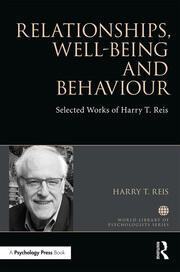
Relationships, Well-Being and Behaviour Selected works of Harry Reis
Theme 1. The relationship context of human behavior
Reis, H. T., Collins, W. A., & Berscheid, E. (2000). The relationship context of human behavior and development. Psychological Bulletin, 126, 844-872.
Reis, H. T. (2008). Reinvigorating the concept of situation in social psychology. Personality and Social Psychology Review, 12, 311-329.
King, K. B., & Reis, H. T. (2012). Marriage and long-term survival after coronary artery bypass grafting. Health Psychology, 31, 55-62.
Caprariello, P. A., & Reis, H. T. (2013). To do, to have, or to share? Valuing experiences over material possessions depends on the involvement of others. Journal of Personality and Social Psychology, 104, 199-215.
Theme 2: The value of studying behavior in its natural context
Reis, H. T., Wheeler, L., Spiegel, N., Kernis, M., Nezlek, J., & Perri, M. (1982). Physical attractiveness in social interaction, II: Why does appearance affect social experience? Journal of Personality and Social Psychology, 43, 979-996.
Wheeler, L., Reis, H. T., & Nezlek, J. (1983). Loneliness, social interaction, and sex roles. Journal of Personality and Social Psychology, 45, 943-953.
Reis, H. T., Sheldon, K. M., Gable, S. L., Roscoe, J., & Ryan, R. M. (2000). Daily well-being: The role of autonomy, competence, and relatedness. Personality and Social Psychology Bulletin, 26, 419-435.
Reis, H. T. (2012). Why researchers should think "real-world": A conceptual rationale. In M. R. Mehl & T. S. Connor (Eds.), Handbook of research methods for studying daily life (pp. 3-21). New York: Guilford.
Carothers, B. J., & Reis, H. T. (2013). Men and women are from Earth: Examining the latent structure of gender. Journal of Personality and Social Psychology, 104, 385-407.
Theme 3. Intimacy and responsiveness
Reis, H. T., & Shaver, P. (1988). Intimacy as an interpersonal process. In S. W. Duck (Ed.), Handbook of personal relationships (pp. 367-389). John Wiley & Sons Ltd.
Reis, H. T., Clark, M. S., & Holmes, J. G. (2004). Perceived partner responsiveness as an organizing construct in the study of intimacy and closeness. In D. Mashek & A. Aron (Eds.), The handbook of closeness and intimacy (pp. 201-225). Mahwah, NJ: Lawrence Erlbaum Associates.
Gable, S. L., Reis, H. T., Impett, E. A., & Asher, E. R. (2004). What do you do when things go right?: The intrapersonal and interpersonal benefits of sharing positive events. Journal of Personality and Social Psychology, 87, 228-245.
Gable, S. L., & Reis, H. T. (2010). Good news! Capitalizing on positive events in an interpersonal context. In M. P. Zanna (Ed.), Advances in Experimental Social Psychology (vol. 42, pp. 195-257). San Diego, CA: Elsevier Academic Press.
Reis, H. T., Maniaci, M. R., & Roger, R. D. (2014). The expression of compassionate love in everyday compassionate acts. Journal of Social and Personal Relationships, 31, 652-677.
Birnbaum, G. E., Reis, H. T., Mizrahi, M., Kanat-Maymon, Y., Sass, O., & Granovski-Milner, C. (2016). Intimately connected: The importance of partner responsiveness for experiencing sexual desire. Journal of Personal
Biography
Harry Reis is Dean's Professor of Psychology at University of Rochester. His research interests include psychological processes that affect the course and conduct of close relationships, such as intimacy, attachment and emotion regulation, and their implications for health and well-being. He is past President of the Society for Personality and Social Psychology and the International Society for the Study of Personal Relationships.
