




1st Edition
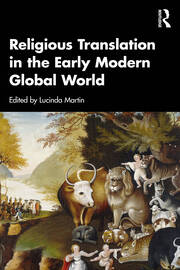
Religious Translation in the Early Modern Global World
List of Figures and Tables
List of Contributors
Acknowledgments
Part I Theoretical Considerations
1. The Problems and Promises of Studying Global Religious Translation - Lucinda Martin
2. Cultural Translation in Theory and Practice - Peter Burke
Part II High and Low
3. An Oriental Tale: Qurʾan Translations in Seventeenth- and Eighteenth-Century France - Alastair Hamilton
4. Kabbalistic Translations Between Learned and Vernacular Knowledge Cultures in Early Modern Central and Eastern Europe - Agata Paluch
5. Open Knowledge: The Vernacular Translation Strategy of the Socinians - Sascha Salatowsky
6. Sinitic and Varieties of Religious Translation in Early Modern Japan: Buddhist and Confucian Traditions - Rebekah Clements
Part III Belief and Knowledge
7. "Come back to Earth!" Human and Sacred Bodies in Zapotec Christian Songs from Colonial Mexico - David Tavárez
8. Alchemical Medicine, Spirituality, and the Language of Nature: Translational Perspectives in Oswald Croll’s Basilica Chymica - Stefan Laube
9. The Arabic-Latin Gospels and the Context of Their Translation, or “Eleven Reasons for Learning Arabic” - Caren Reimann
Part IV Surface and Subterfuge
10. The Latin of the Babylonian Talmud: Assessing Boundaries Between Judaism and Christianity in the Thirteenth Century - Federico Dal Bo
11. “Do not our Englyshe Protestantes [do] so lykewyse?” Translation, Power, and the Elizabethan Religious Controversies - Elisabeth Natour
12. Translating Christianity in Late Imperial China: Giulio Aleni’s Adaptation of Jeronimo Nadal - R. Po-chia Hsia
13. Vernacular Translation as Subtext: The Missing Slave in Jacobus Capitein’s Fante Primer (1744) - Joseph Fosu-Ankrah and Martha Frederiks
Part V Administration and Utopia
14. Translation, the Untranslatable and Resistance: Syrian Christians of South India - Bivitha Easo
15. Lost in Translation: Evaluating the Ambonese Embassy to the United Provinces (1620–1631) Between Success and Failure - Leigh T.I. Penman
Index
Biography
Lucinda Martin is a researcher at the Gotha Research Centre of the University of Erfurt in Germany. Her publications focus on early modern religion, lay theology, religious translation, the religious roots of modern human rights, and art as a medium of nonconformist religion. She has also curated numerous international exhibitions on early modern books and the mystical philosopher Jacob Böhme.
"This is a landmark book. Translation is such an important subject, and Lucinda Martin has assembled here a most impressive cast of experts for what is a compendious global sequence of fascinating case studies. This book will be indispensable to anyone interested in the history of communication." - Andrew Pettegree, Professor of Modern History, University of St Andrews
"We all need translation—across languages, cultures, and religions. This rich volume shows how strategies of translation have shaped our world since the late Middle Ages. The expert contributions reveal striking instances of cultural and religious interaction across the globe. I learned something on every page." - Volker Leppin, Yale Divinity School
"This volume compellingly demonstrates that religion and translation were deeply intertwined in the Early Modern period. A group of renowned intellectual historians traces these entanglements across a wide geographic range—from Japan to Mexico, from the Islamic world to China—making the book as enlightening as it is enjoyable." - Martin Mulsow, Gotha Research Centre, University of Erfurt
