




1st Edition
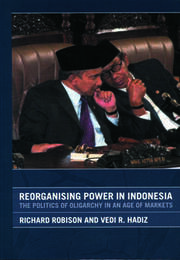
Reorganising Power in Indonesia The Politics of Oligarchy in an Age of Markets
Biography
Richard Robison is Professor of Political economy at the Institute of Social Studies in the Hague, The Netherlands and was formerly Director of the Australian Research Council's Special Centre for the Study of Political and Economic Change in Asia at Murdoch University, Australia.
Vedi Hadiz is Assistant Professor in the Department of Sociology at the National University of Singapore and was previously Research Fellow at the Asia Research Center, Murdoch University, Australia.
'Richard Robison and Vedi Hadiz have delivered the most comprehensive and analytically sound book on the politics of post-New Order Indonesia written so far.' - The Jakarta Post
'In this information-packed and theoretically sophisticated analysis, Robison and Hadiz brilliantly argue that, in spite of Indonesia's economic successes and the collapse of Suharto's regime, power arrangements in the country still operate to keep an oligarchy in command.' - Lucien W. Pye, Foreign Affairs
'[This] is the first study to spell out the nature of the relationship between a national oligarchy and the global market place. As such it is not only an important empirical study, it also represents a major critique of the neo-classical understanding of development that prevailed throughout the late 20th century.' - Richard Higgott, Editor, The Pacific Review
'Russia and the other transition economies have taught us that policy change involves a struggle over assets and that market-oriented reform can be hijacked to sustain, or even generate, new structures of power and corruption. In this powerful and historically rich book, Robison and Hadiz make the same point for the Indonesian oligarchy, showing its tremendous resilience in the face of a variety of external and internal pressures, from the IMF to the democratic opposition.' - Stephan Haggard, University of California San Diego, USA
'Vedi Hadiz and Richard Robison argue that what is taking place in Indonesia is the reorganization of the power relations incubated within the Soeharto regime rather than their fundamental transformation, and that democratizing was instituted for the survival of the interests nurtured under Soeharto's rule as the institutional structures of the New Order became unviable. A must read for anyone interested in Indonesia and "Third World" transformations.' - Takashi Shiraishi, Kyoto University, Japan'The authors have provided a book that uses a single analytic framework to rethink the New Order [...] in a tightly coherent and highly detailed narrative. Not surprisingly, this book has already become required reading for those interested in Indonesian politics. It will continue to do what good books do—generate debate and new lines of research—and will significantly advance our understanding of Indonesian politics.' - Erick M. Danzer, Indonesia 82 (October 2006)
