





1st Edition
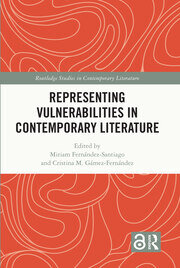
Representing Vulnerabilities in Contemporary Literature
List of Tables
List of Contributors
Preface by Janet Wilson
Introduction
Current Literary Representations of Vulnerability. Ethical and Aesthetic Concerns
Miriam Fernández-Santiago and Cristina M. Gámez-Fernández
Chapter 1
Precarity and the Global Dispossession of Indigeneity through Representations of Disability
David T. Mitchel and Sharon L. Snyder
Chapter 2
Performing Ceremony: Healing, Empowering, Re-Writing History in Alexis P. Gumbs’ Dub (2020)
Esther Sánchez-Pardo
Chapter 3
The Visibility of Embeddings: Materiality, Vulnerability and Care in Cynan Jones’s The Long Dry (2006)
Jean-Michel Ganteau
Chapter 4
Pretty Dolls Don’t Play Dice: The Calculated Vulnerabilities of Jennifer Egan’s Manhattan Beach (2017)
Miriam Fernández-Santiago
Chapter 5
Wolves, Bees, and Roaches: On the Nexus between Cultural Production and the Vulnerability of Humans and Non-Human Species
Peter Arnds
Chapter 6
"The ones we love are enemies of the state": Mourners and Trespassers in Kamila Shamsie’s Home Fire (2017)
Carolina Sánchez-Palencia
Chapter 7
Mapping Contemporary Hell: Vulnerability, Social Invisibility and Spectral Mourning in Jon McGregor’s Even the Dogs (2010)
Susana Onega
Chapter 8
The Logics of Vulnerability: Challenging the Ungrievable Diffeìrance of the Other in Tabish Khair’s Just Another Jihadi Jane (2014)
Cristina M. Gaìmez-Fernández
Chapter 9
Technological Vulnerability in the Fourth Industrial Revolution: Don DeLillo’s The Silence (2020)
Sonia Baelo-Allué
Chapter 10
When Immortality Becomes a Burden: Transhuman Vulnerability and Self-consciousness in William Gibson’s Neuromancer (1984)
Francisco Collado-Rodríguez
Chapter 11
Vulnerability and Risk in Larissa Lai’s Critical Dystopias
Mónica Calvo-Pascual
Index
Biography
Miriam Fernández-Santiago is Head of the English Department at the University of Granada (Spain), where she teaches courses on Literatures and Cultures in English at graduate and undergraduate level. Her current research interests focus on contemporary literature in English, critical posthumanism, vulnerability and disability studies.
Cristina M. Gámez-Fernández is a Senior Lecturer of English in the Department of English and German at the University of Córdoba (Spain) and a founding member of the Challenging Precarity network. With Leonor María Martínez-Serrano, she has recently co-edited Modern Ecopoetry: Reading the Palimpsest of the More-than-human World (Brill, 2021).
"Examining vital cultural themes of vulnerability and precarity, this compelling volume offers fresh readings of a wide range of contemporary literary texts. As we imagine a post-Covid cultural landscape, Representing Vulnerabilities in Contemporary Literature astutely identifies those central questions which urgently require scholarly consideration. The volume’s critical engagement with vulnerability and the politics of representation makes it an essential companion to contemporary literary and cultural studies."
-Dr Charlotte Beyer, Senior Lecturer in English Studies, University of Gloucestershire, UK
"I highly recommend this timely, stimulating book which limns the effects of reading vulnerability in literary texts."
-Cheryl Stobie, Professor of English, University of KwaZulu-Natal, South Africa
"This is an important, rich, and fascinating collection of studies of literary portrayals of vulnerability. Informed by a wide-ranging and incisive set of theoretical approaches, the book makes significant steps towards better grasping the nature of vulnerability and the challenges in representing this aspect of the (trans)human condition."
-Patrick Brown, Associate Professor in Sociology, University of Amsterdam, Netherlands
"The volume Representing Vulnerabilities in Contemporary Literature (2023) is an extraordinary finding within the field of vulnerability studies as it explores, as the editors prove with an extensive and incisive bibliographical revision of works in the same field, the inherent problematic nature of both the conceptualization of the term vulnerability, and its representation in contemporary literary depictions of it, particularly emphasizing how these depictions might complicate its portrayal from ethical and aesthetic perspectives.......both experimented scholars on vulnerability studies and young researchers will find the introduction and the whole collection of chapters incredibly helpful as the volume discerns and exemplifies new attitudes towards the representation of vulnerability and the problematization of precisely these exact representations in very interesting and varied attitudes and fields within literary studies."
Alejandro Sánchez Cabrera, Nexus, vol 1: p. 108, 2023
